2-Night Northern Lights Cruise from Hull to Norway
Introduction and Article Outline: What This Short Cruise Really Offers
Short cruises hold a special appeal because they promise a break from routine without demanding a week of annual leave, and a sailing from Hull to Norway adds the drama of the North Sea to that convenience. Yet the phrase Northern Lights often creates expectations that deserve a calm, informed explanation. This article looks at the route, the onboard experience, the geography of aurora viewing, and the practical trade-offs of choosing only two nights. By the end, you should know whether this compact voyage suits your budget, schedule, and sense of adventure.
A 2-night cruise from Hull to Norway sits at the intersection of convenience and aspiration. For travellers in northern and central England, Hull is an accessible departure point that can feel easier than flying from London or Manchester, especially when winter weather, baggage rules, and airport queues are factored in. Add the promise of Norway, a country associated with fjords, snow-dusted coastlines, and dark northern skies, and the concept becomes immediately attractive. It sounds like an efficient way to sample a much bigger dream.
That dream, however, needs context. The Northern Lights, or aurora borealis, are not a guaranteed attraction like a museum ticket or a timed excursion. They depend on solar activity, cloud cover, darkness, and, crucially, latitude. Hull sits at roughly 53.7 degrees north. Southern Norwegian ports such as Oslo, Stavanger, or Bergen lie farther north, but they are still well south of the auroral sweet spot that includes places like Tromso, which is close to 69.6 degrees north. That means a two-night cruise may offer a winter sea break with a chance of atmospheric drama, but it should not be mistaken for a full-scale Arctic aurora expedition.
This is exactly why the topic matters. Many travellers want shorter holidays, lower planning stress, and memorable experiences that fit around work and family schedules. A compact sailing can absolutely deliver relaxation, scenery, and a sense of escape. It can also provide the thrill of scanning a dark deck after dinner while the sea rolls quietly below. But value comes from matching expectations to reality.
This article is arranged in five parts:
• what the cruise concept means and why it appeals;
• how the route from Hull to Norway shapes the experience;
• what life onboard feels like during a winter mini-break;
• how realistic Northern Lights viewing is on such a short itinerary;
• who should book, what to compare, and how to decide wisely.
If you approach the cruise with curiosity rather than certainty, it becomes more interesting, not less. The best travel decisions are rarely built on fantasy alone. They are built on knowing what a trip can genuinely offer, and then letting the magic arrive, if it chooses to, as a bonus rather than a promise.
Route, Distance, and Geography: Why the Journey Matters as Much as the Destination
To understand a 2-night Northern Lights cruise from Hull to Norway, it helps to picture the map before picturing the sky. Hull lies on England’s east coast, making it a natural gateway to North Sea sailings. From there, a ship can cross toward Norway more directly than a vessel departing from the south coast of Britain. Even so, Norway is a long, stretched country, and not all parts of it are equally suitable for aurora hunting. Geography is the quiet truth behind the marketing headline.
A short crossing from Hull is most realistic for southern or southwestern Norwegian ports. Depending on itinerary design, a mini-cruise might prioritize sea time, a brief scenic arrival, or a short call in port before the return journey. What matters is that two nights is simply not enough time for a standard cruise ship to travel from Hull to the high Arctic regions where aurora sightings are far more common. Cities such as Bergen, Stavanger, and Oslo are beautiful winter destinations, but they are significantly farther south than Tromso, Alta, or Kirkenes, which are often featured in dedicated Northern Lights holidays.
This difference has practical consequences. The auroral oval, the band around the Earth where aurora activity is strongest, typically favors higher latitudes. In broad terms, the most reliable viewing areas in Scandinavia are in northern Norway, often between about 65 and 75 degrees north. Bergen is around 60.4 degrees north, Oslo around 59.9, and Stavanger around 59. That does not mean aurora can never be seen from southern Norway or at sea farther south. Strong solar storms can push the lights farther down. It does mean, however, that the odds are lower and the experience is less predictable.
There is also a useful comparison to make:
• A 2-night sailing is best viewed as a compact winter cruise with a possible aurora bonus.
• A 5- to 7-night Norwegian cruise offers more coastal range, more dark-sky time, and more chances for clear weather.
• A fly-and-stay trip to northern Norway usually gives the strongest aurora odds, but it sacrifices the seaborne experience that some travellers love.
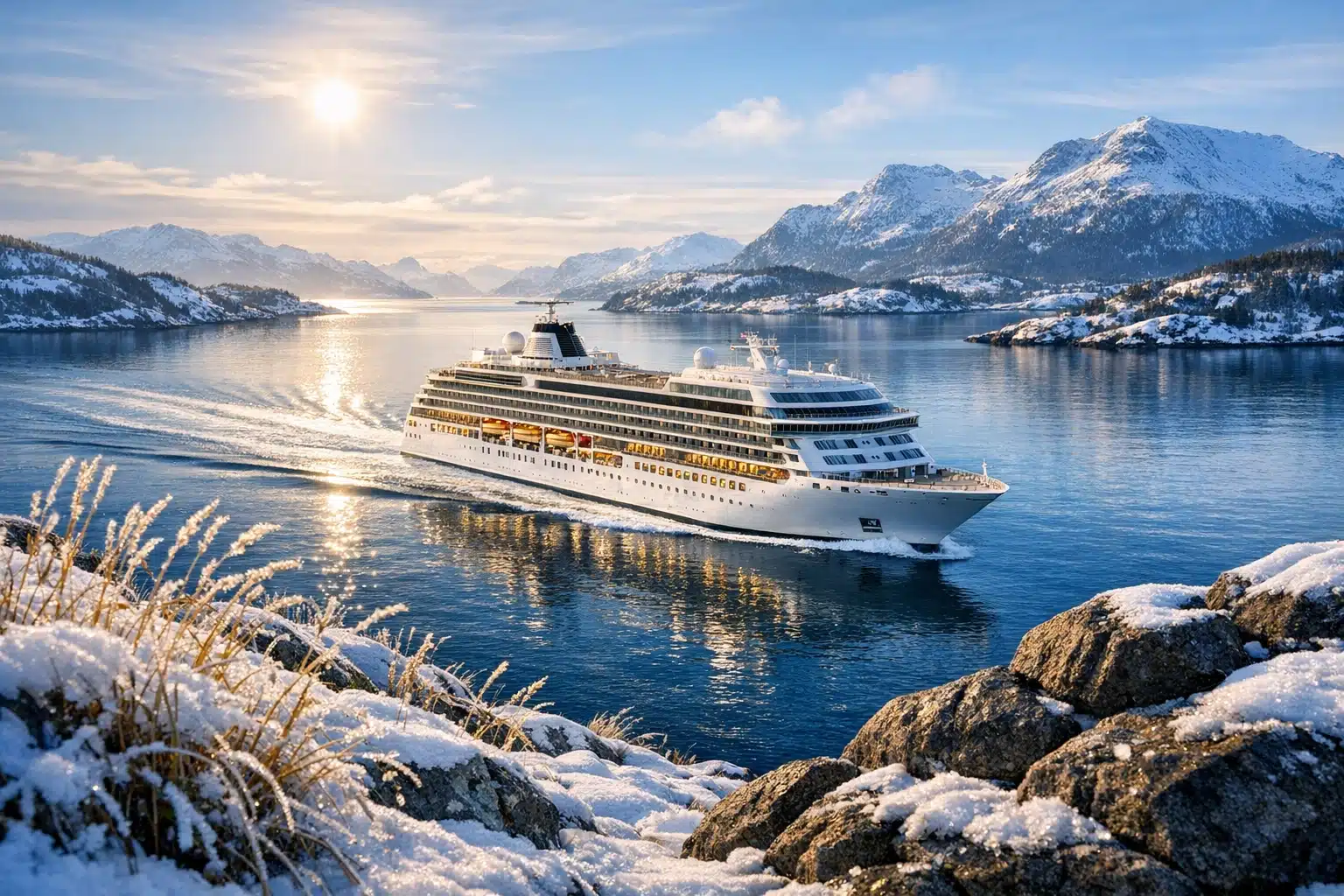
The route itself has its own appeal. Winter sea crossings can feel cinematic. You leave familiar British roads and city lights behind, and by evening the ship is surrounded by dark water and weather that seems to belong to a different century. There is drama in that transition. On a clear night, the lack of urban light pollution can make the sky appear unusually rich, even if the aurora never arrives. Stars sharpen. Wind bites. The deck becomes a place of quiet anticipation.
So the route matters not only because it determines what is possible, but because it defines the character of the trip. This is not merely transport to Norway. It is a short immersion in winter maritime travel, shaped by distance, latitude, and the realities of the North Sea.
Life Onboard a Two-Night Winter Cruise: Atmosphere, Comfort, and the Pace of the Experience
A two-night cruise is a curious little format. It is long enough to create separation from everyday life, yet short enough that every hour feels important. On a winter sailing from Hull to Norway, the ship becomes less of a hotel and more of a compact floating town, with its own routines, weather moods, and unspoken social rhythm. People board with weekend bags, thick coats, and a private hope that something memorable will happen after dark.
The first thing many travellers notice is how quickly the cruise settles into a pattern. After embarkation comes the practical choreography of finding the cabin, learning the layout, checking dining times, and perhaps stepping onto an outer deck for that first cold gust of sea air. The departure itself can be unexpectedly emotional. Dockside structures slide away, land loosens its grip, and the voyage begins not with a dramatic speech but with the slow confidence of engines doing their work.
Because the trip is short, onboard design matters more than on a longer itinerary where shore days dominate. Travellers usually pay attention to:
• cabin type, especially whether an inside cabin is acceptable on a winter trip with long dark hours;
• deck access, since open viewing areas are important for skywatching;
• dining flexibility, because fixed meal slots can clash with aurora alerts or time on deck;
• lounges and observation spaces, which become central gathering points in rough or cold weather.
Sea conditions are another part of the story. The North Sea can be calm, but it can also be lively, especially in winter. Some passengers enjoy the movement and find it part of the adventure. Others discover, a little too late, that romance fades when the floor starts tilting under breakfast. If you are prone to motion sickness, this is not a minor detail. Sensible packing, medication advice from a pharmacist, and choosing a lower, more central cabin can all help.
The onboard atmosphere often shifts after sunset. During the day, public spaces can feel practical and busy. At night, the ship changes character. Windows reflect warm interior lights, glasses clink softly in the bar, and every announcement about weather or viewing conditions draws attention. There is a lovely tension between comfort and exposure: inside, everything is lit and warm; outside, the deck is dark, cold, and full of possibility. That contrast is part of what makes these sailings memorable.
Food, entertainment, and service also shape the perceived value of the trip. On a longer cruise, a mediocre meal can be forgotten. On a two-night sailing, it becomes a larger share of the total experience. The same is true for service efficiency, cabin cleanliness, and nighttime access to hot drinks after standing outside in the cold. Small touches matter more because the trip is concentrated.
In the end, the onboard experience is not just filler between departure and arrival. On this kind of cruise, it is the holiday. Even travellers who never see the aurora can come away feeling that they had a proper winter escape, complete with sea air, changing skies, and the oddly satisfying feeling of waking up in motion.
Northern Lights Reality Check: Best Season, Viewing Conditions, and How to Judge Your Chances
The Northern Lights inspire a particular kind of travel optimism. People imagine curtains of green light waving above a silent deck, and sometimes that image becomes real. Still, aurora viewing is governed by science and weather, not wishful thinking. If you are considering a 2-night cruise from Hull to Norway, understanding the variables will help you enjoy the trip for what it is and avoid disappointment based on unrealistic expectations.
The aurora happens when charged particles from the Sun interact with gases in the Earth’s upper atmosphere. That interaction is guided toward the polar regions by the planet’s magnetic field, which is why higher latitudes offer stronger and more frequent displays. Darkness is essential too, so the main viewing season in Norway runs from autumn into early spring, often from late September to March. Winter gives the longest dark periods, but more darkness does not automatically equal more aurora. You still need cloud breaks and sufficient solar activity.
This is where a short cruise faces its biggest limitation: lack of time. Even if the ship reaches a reasonably dark area, passengers only have a small number of nighttime hours available. A week-long voyage might offer several clear evenings and changing positions under the sky. A two-night trip may offer only one strong viewing window, or none at all if cloud cover closes in. Marine weather can shift quickly, which occasionally helps, but it can also erase an otherwise promising forecast.
A sensible way to think about the odds is this:
• latitude affects the baseline probability;
• cloud cover affects whether anything is visible at all;
• solar activity affects the intensity of the display;
• time on itinerary affects how many opportunities you get.
Short cruises from Hull are therefore better suited to travellers who can appreciate the atmosphere of trying, not just the certainty of succeeding. On a clear deck, the act of waiting becomes part of the experience. You watch the horizon disappear into darkness. Someone points at a pale band that turns out to be cloud. A crew member mentions a break in the sky off the port side. Then everyone looks up again. Even without a full aurora, the night can feel charged with expectation.
Comparisons are useful here. If your main goal is to maximize the chance of seeing the Northern Lights, a land-based trip to Tromso or Alta, ideally with three or more nights, is usually a stronger choice. If your goal is a low-commitment winter getaway with the possibility of seeing something extraordinary, the cruise becomes much more attractive. These are not the same holiday, and disappointment often comes from confusing one with the other.
Before booking, check whether the operator provides honest wording. Good signs include phrases such as “chance to see the Northern Lights,” “weather permitting,” and “subject to solar activity.” Be cautious of language that makes the lights sound routine or nearly guaranteed. Nature does not perform on schedule. When it does appear, that is exactly why people remember it for years.
Who This Cruise Suits, How to Compare It with Other Options, and a Final Word for Travellers
A 2-night Northern Lights cruise from Hull to Norway makes the most sense for travellers who value ease, atmosphere, and novelty as much as outcome. It can suit couples looking for a winter mini-break, friends wanting something more distinctive than a city weekend, and first-time cruisers who prefer testing the format before committing to a longer voyage. It may also appeal to travellers who live within practical reach of Hull and like the idea of stepping onto a ship with minimal airport hassle. For these people, the cruise offers a neat package: transport, accommodation, food, entertainment, and a genuinely evocative setting.
It may be less suitable for travellers with one overriding goal: seeing the aurora at almost any cost. If that is you, the smarter comparison is not between one cruise and another, but between cruising and flying north. A direct trip to northern Norway usually involves more planning and often higher total cost, yet it provides far better aurora geography and more time under dark skies. By contrast, the short cruise wins on simplicity and charm.
When comparing options, focus on practical questions rather than romantic slogans:
• Which Norwegian port or sailing area is actually included?
• How many nighttime hours at sea are there in dark conditions?
• Are outside decks accessible late at night?
• What is included in the fare, and what costs extra?
• Is the cruise sold primarily as a mini-break, a scenic voyage, or a serious Northern Lights experience?
Budget matters too, though not only in the obvious sense. A cruise fare can look competitive because it bundles lodging and transport, but value depends on cabin choice, dining inclusion, drinks, parking, and travel to Hull. Meanwhile, a fly-and-stay trip may appear expensive up front, yet it can deliver more destination time and stronger aurora potential. The better purchase depends on what you are trying to buy: convenience, experience, or probability.
There is also the emotional side of travel, which should not be dismissed. Some trips are worth taking because they create a mood you cannot get elsewhere. A winter sailing has that quality. The harbor lights recede, the sea opens, and for a while your world becomes corridors, decks, wind, darkness, and the possibility of a sky turning strange above you. That is not a small thing.
For the target audience, the clearest conclusion is this: book the cruise if you want a memorable short escape from Hull with Norwegian flavor and a realistic chance, not a promise, of seeing the Northern Lights. Choose a longer or farther-north itinerary if the aurora is your central mission. In other words, let the trip be what it is. When expectations are honest, even a brief voyage can feel surprisingly rich, and if the sky happens to glow, the memory will feel earned rather than advertised.