 Artificially generated image
 2-Night Northern Lights Cruise from Dover: What to Expect
A 2-night Northern Lights cruise from Dover sounds wonderfully simple: step aboard in Kent, trade city lights for open water, and spend two evenings scanning the northern sky. Yet this kind of trip matters because it blends a short, manageable escape with a big travel dream, making it attractive to first-time cruisers, busy professionals, and curious stargazers alike. The key is to understand both its charm and its limits, especially when it comes to the real odds of seeing the aurora.
1. Article Outline and the Big Appeal of a Short Northern Lights Cruise
Before diving into the details, it helps to map out what this article covers and why the subject deserves a closer look. A 2-night Northern Lights cruise from Dover is not just another mini-break. It sits at the intersection of accessible travel, winter sightseeing, and wish-list adventure. For many people in southern England and nearby regions, Dover is a practical embarkation point with rail, road, and port links that make departure far less complicated than flying to northern Scandinavia. That convenience alone explains why these short sailings generate so much interest.
This article is organized around five main questions that most travelers ask before booking:
- What makes a 2-night Northern Lights cruise different from a standard mini-cruise?
- What is the journey from Dover actually like in terms of timing, route, and onboard atmosphere?
- How likely are you to see the aurora on such a short voyage?
- What should you budget, pack, and prepare for before departure?
- Who is this trip best suited to, and when does a longer Arctic itinerary make more sense?
The relevance of the topic comes from the mismatch between expectation and reality. Promotional language can make any aurora-themed trip sound cinematic, with emerald ribbons dancing over a dark horizon as soon as the ship leaves port. Real travel is more nuanced. The Northern Lights are a natural phenomenon shaped by solar activity, darkness, latitude, and cloud cover. A short cruise from Dover can be exciting, atmospheric, and genuinely memorable, but it should not be treated as an assured ticket to a spectacular sighting.
That said, there is still a strong case for this kind of break. It offers a low-friction way to sample cruising in winter. It creates a change of pace without requiring a week away from work. It also introduces travelers to the romance of open decks, cold sea air, and night skies that feel larger than they do on land. Even when the aurora remains elusive, the experience can still deliver comfort, novelty, and a sense of seasonal escape. Think of it less as a guaranteed light show and more as a compact voyage built around the possibility of one.
2. From Dover to Open Water: Embarkation, Itinerary, and the Onboard Rhythm
A 2-night cruise from Dover typically begins with the pleasant logistics that make short British sailings attractive. Unlike a fly-cruise, you are usually dealing with one terminal, manageable luggage rules, and a much shorter chain of travel decisions. Arriving at the port often feels like the first reward. White cliffs, a working harbor, and the visible scale of the ship combine to create that unmistakable transition from ordinary routine to travel mode. Even a seasoned traveler can feel a flicker of anticipation at the gangway.
Most itineraries of this length are simple by design. There is usually embarkation during the afternoon, followed by departure in the late afternoon or evening. After that, the cruise becomes largely sea-focused rather than destination-focused. On a Northern Lights-themed voyage, the ship may spend time in the North Sea or head toward waters where darkness and clear conditions give at least some chance of aurora visibility. Because the trip is short, the route is shaped more by weather, navigation, and viewing opportunities than by multiple port calls.
Life on board follows a gentle rhythm that is part practical and part indulgent. Expect several familiar cruise elements:
- A sail-away period with deck views and plenty of photography
- Buffet or restaurant dining on the first evening
- Bars, lounges, and light entertainment rather than a packed sightseeing schedule
- Announcements or guidance if there is a possibility of aurora activity overnight
- A second day that may feel like a relaxed sea day with lectures, quizzes, spa visits, or panoramic lounging
The atmosphere on these voyages is often different from a summer cruise. Winter passengers tend to be more focused on the shared theme of the trip. People check weather apps, compare forecasts, and drift onto outside decks after dark with hats pulled low and phones ready. There is a pleasing sense of collective curiosity. Nobody can command the sky, so everyone is waiting together.
Compared with a traditional city-break, the onboard experience is slower and more enclosed. Compared with a week-long cruise, it is intentionally compressed. You may not sample every restaurant, show, or facility before the return to Dover begins. Yet that brevity can also be refreshing. There is little pressure to optimize every hour. The point is not to conquer an itinerary. The point is to settle into the ship, embrace the season, and keep a watchful eye on the horizon after dark.
3. The Critical Question: How Likely Are You to See the Northern Lights?
This is the section that matters most, because it shapes whether a traveler ends the trip delighted or disappointed. The honest answer is that a 2-night Northern Lights cruise from Dover can offer a chance of seeing the aurora, but the probability is lower than on longer voyages or land trips farther north. That is not a flaw in the concept. It is simply a matter of geography and time.
The Northern Lights occur when charged particles from the sun interact with gases in Earth’s upper atmosphere, producing visible light. The strongest and most frequent displays tend to cluster around the auroral oval, which sits much farther north than Dover. Dover is roughly 51 degrees north. By comparison, popular aurora destinations such as Tromso sit near 69 degrees north, while much of Iceland is around 64 degrees north. A two-night sailing from southern England has limited time to reach higher latitudes, which means any sighting often depends on unusually strong geomagnetic activity, very dark skies, and cooperative cloud conditions.
Several variables need to align at once:
- Darkness: winter sailings are best because the nights are longer
- Clear skies: cloud cover can hide even strong aurora activity
- Solar activity: stronger geomagnetic storms increase the chance of southern visibility
- Ship position: distance from coastal light pollution can help, but latitude still matters
- Timing: a short voyage offers only a small viewing window compared with a week-long trip
This is where comparison helps. A two-night cruise from Dover is best viewed as an opportunity-based experience. A dedicated aurora holiday in northern Norway is an odds-based experience. On a Norway trip, your whole location strategy is built around the phenomenon. On a Dover mini-cruise, the aurora is the headline, but the ship is still departing from a comparatively southern port and working within a brief schedule.
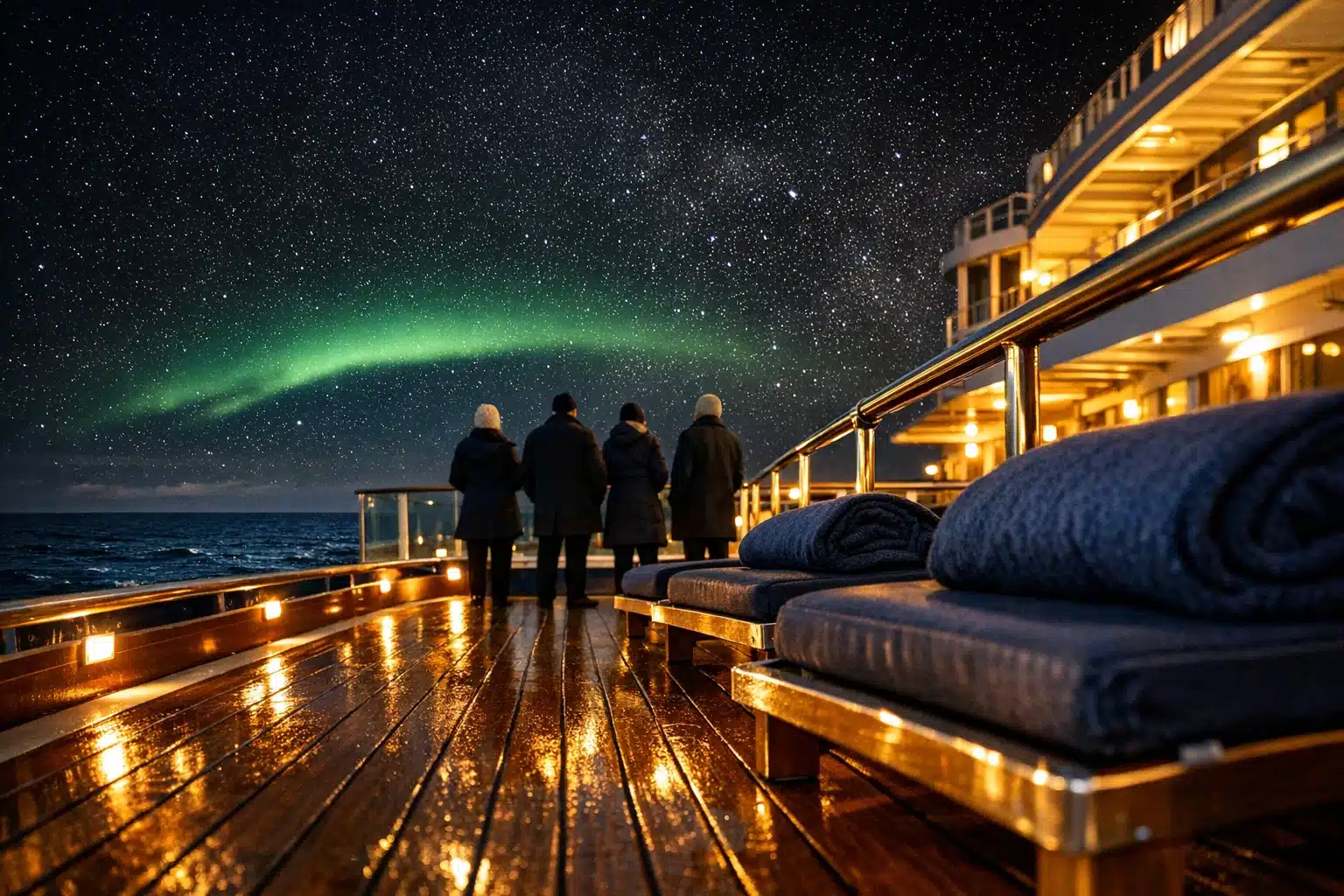
That does not make the voyage pointless. During periods of heightened solar activity, the lights have occasionally been visible much farther south than usual, including parts of the UK. Being at sea can improve the visual experience because there is less urban glow and a broader horizon line. If the conditions line up, the moment can feel extraordinary precisely because it was not easy to predict. One minute you are looking at what seems to be a dark, empty sky. The next, a pale arc appears like chalk brushed across velvet, and the deck suddenly grows quiet.
The most practical mindset is this: book the cruise because you like the overall experience, and treat any aurora sighting as a genuine bonus. If seeing the lights is your non-negotiable goal, a longer itinerary departing from higher latitudes will usually be the stronger choice.
4. Budget, Cabins, Packing, and Comfort: The Details That Shape the Trip
Short cruises can appear straightforward on paper, yet the quality of the experience often comes down to small decisions made before departure. On a two-night sailing, you do not have much time to recover from poor packing, an inconvenient cabin choice, or unrealistic spending assumptions. Planning well means the voyage feels easy rather than improvised.
Budget is the first consideration. A mini-cruise fare may look attractive, but travelers should check what is and is not included. Some fares cover accommodation, standard meals, and onboard entertainment. Extras can quickly reshape the total cost, especially if you add drinks packages, specialty dining, spa treatments, premium Wi-Fi, or parking at the port. If you live close enough to reach Dover by train or car in a single day, that keeps costs lower than an international aurora trip involving flights, hotels, and transfers. However, a cheap fare does not automatically make the cruise a bargain if you are expecting Arctic-level viewing conditions that the route cannot reliably deliver.
Cabin selection matters more than many first-time cruisers expect. For a two-night trip, an inside cabin can be perfectly reasonable if you mainly want a base for sleeping and changing clothes. An ocean-view cabin gives you natural light and a stronger sense of being at sea. A balcony can sound tempting, but in cold, windy conditions it may be less useful than travelers imagine, especially if public outside decks offer better viewing angles. People prone to motion sensitivity may prefer a cabin in a lower, more central part of the ship where movement often feels less pronounced.
Packing should be practical rather than glamorous. Bring layers and think about standing still outdoors at night rather than walking briskly through town. A good packing list usually includes:
- A warm coat that blocks wind
- Hat, scarf, and gloves
- Comfortable shoes with grip for wet decks
- A phone power bank or spare camera battery
- Any seasickness remedies you trust
- Simple evening wear that matches the ship’s dress expectations
Comfort also depends on attitude. Winter sea conditions can be rougher than summer sailings, and a North Sea crossing may feel lively. Some passengers love that sense of movement because it adds drama to the trip. Others discover very quickly that they prefer calm water. If you are unsure, prepare in advance instead of hoping for the best. A little foresight can turn the cruise from a novelty that feels tiring into a compact holiday that feels genuinely restorative.
5. Final Thoughts for First-Time Cruisers and Aurora Dreamers
For the right traveler, a 2-night Northern Lights cruise from Dover can be a smart and satisfying choice. It works especially well for people who are aurora-curious but not yet ready to invest the time and money required for a full northern expedition. It also suits couples looking for a seasonal break, friends who enjoy themed travel, and first-time cruisers who want to test the experience without committing to a long itinerary. In those cases, the cruise offers an appealing mix of convenience, atmosphere, and manageable cost.
The key is matching the trip to your expectations. If your ideal outcome is a relaxing voyage with winter scenery, cozy interiors, sea air, and the outside possibility of a remarkable sky event, this format can be excellent. If your ideal outcome is a high-probability aurora chase with multiple nights under the northern sky, you may be better served by traveling farther north and staying longer. That comparison is not meant to diminish the Dover option. It simply clarifies what success looks like.
To get the most from the trip, focus on a few practical habits:
- Monitor aurora forecasts, but do not obsess over every hourly change
- Join ship announcements or talks if the crew offers them
- Step outside periodically rather than waiting for a perfect alert
- Keep your camera settings simple unless you already know night photography well
- Enjoy the ship itself instead of treating every indoor moment as lost time
There is also a broader travel lesson here. Some journeys are valuable because they deliver exactly what was promised. Others are memorable because they leave room for uncertainty. A short Northern Lights cruise belongs to the second category. The sky may stay dark. The clouds may linger. The ship may rock a little more than expected. Yet those same variables are what give the voyage its character. When a break from routine includes salt air, winter horizons, and the possibility of seeing something ancient and luminous above the sea, it earns its appeal honestly.
So, who should book it? Choose this cruise if you want a brief, atmospheric getaway from southern England with a realistic shot at something special. Choose another format if your priority is maximizing aurora odds above all else. For travelers who understand that difference, a 2-night sailing from Dover can be less about chasing certainty and more about enjoying the rare pleasure of being out on dark water, looking up, and waiting with purpose.