8-Day All-Inclusive Ireland Tour Package Guide
Outline and Why an 8-Day Ireland Tour Makes Sense
Planning an Irish vacation sounds romantic right up to the moment you start comparing routes, hotel bases, airport transfers, and weather charts that seem to change by the hour. That is exactly why the 8-day all-inclusive format has become so popular: it bundles the big moving pieces into one manageable plan. With a good itinerary, you can move from Dublin streets to Atlantic cliffs and village pubs without constantly repacking your brain. The sections below map out the structure, trade-offs, and practical details that help travelers choose wisely.
Outline at a glance:
• Why eight days is a practical sweet spot
• What a typical day-by-day route looks like
• What “all-inclusive” usually covers and what it may not
• How to compare packages by value, pace, and season
• Who benefits most from this travel style and how to prepare
Eight days works especially well in Ireland because it offers enough time to experience variety without turning the trip into a blur of coach windows and hotel lobbies. A five-day tour can feel rushed, particularly if it tries to fit Dublin, the west coast, and the southwest into one short sweep. By contrast, a 10- to 14-day trip allows deeper exploration, but not every traveler has that kind of flexibility. Eight days is the middle ground. It is long enough to include two or three distinct regions, but short enough to fit into a standard vacation schedule.
Geography supports this format. Ireland is compact compared with many European destinations, yet travel still takes time on rural roads. Dublin to Galway is often around 2.5 to 3 hours by road, while Galway to Killarney can stretch to 3.5 or 4 hours depending on route and stops. An organized package reduces the strain of planning these connections, especially for first-time visitors unfamiliar with driving on the left or reading local timetables. It also removes the need to compare dozens of hotels, admission tickets, and transfer options one by one.
The other reason this format remains relevant is predictability. Travelers with limited time often want to know where they will sleep, how they will move between regions, and which sights are realistically achievable in a week. A strong package answers those questions early. It does not guarantee perfection, and it should not be mistaken for luxury by default, but it can create a smoother experience. For couples, solo travelers, small friend groups, and multigenerational families, that clarity is often worth more than endless flexibility.
A Realistic Day-by-Day Framework for an 8-Day Ireland Tour
Most 8-day all-inclusive Ireland tours follow a version of a classic route rather than trying to cover the entire island. That is usually a good thing. Trying to include Dublin, Galway, Kerry, Cork, Belfast, and Donegal in one week sounds exciting on paper, but in practice it can leave travelers with little more than photographs taken between bus departures. The strongest itineraries choose a rhythm and stick to it. A common and well-balanced version uses Dublin for arrival, Galway or Clare for the west, Killarney for the southwest, and a final return east before departure.
A representative schedule often looks like this:
• Day 1: Arrive in Dublin, transfer to hotel, gentle orientation walk
• Day 2: Dublin sightseeing, perhaps Trinity College, Dublin Castle, or a literary or whiskey-themed tour
• Day 3: Travel west with stops such as Clonmacnoise, Athlone, or Kilbeggan before reaching Galway
• Day 4: Excursion to Connemara, the Cliffs of Moher, or the Burren
• Day 5: Transfer south toward Killarney, often via Limerick, Adare, or Bunratty
• Day 6: Ring of Kerry or Dingle Peninsula touring
• Day 7: Return east, possibly with a heritage stop such as the Rock of Cashel or Kilkenny
• Day 8: Departure
This route works because it mixes city energy, coastal scenery, and smaller-town atmosphere. Dublin provides history, museums, and easy arrival logistics. Galway adds a livelier west-coast character, with music spilling from pubs and stone streets that feel active without being overwhelming. Killarney, meanwhile, is a reliable base for some of Ireland’s most famous scenery, whether the tour chooses the Ring of Kerry, the Dingle Peninsula, or Killarney National Park.
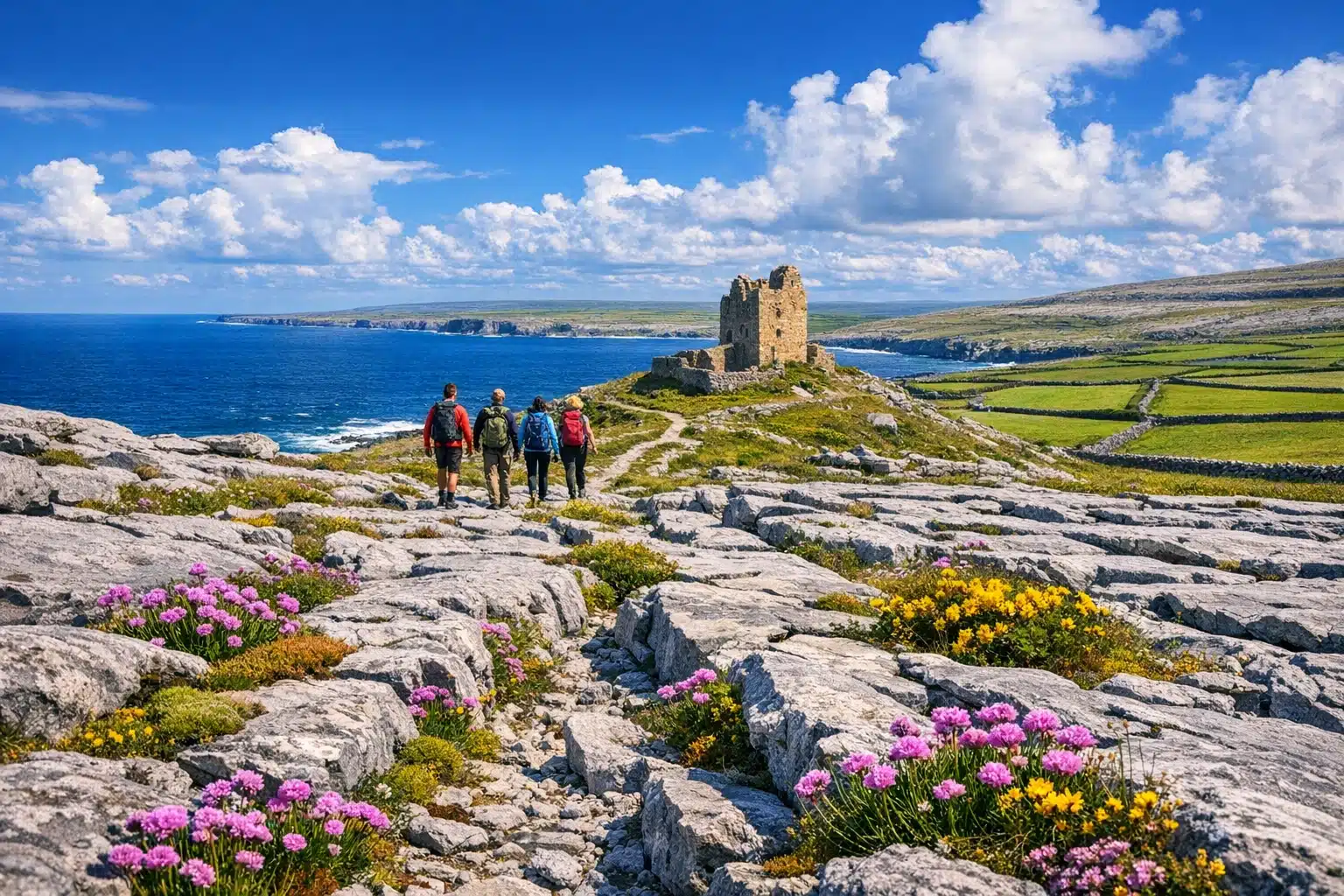
Good tours also understand the value of scenic stops. The Cliffs of Moher, for instance, rise to about 214 meters at their highest point and remain one of Ireland’s signature landscapes for a reason. The Burren adds contrast with its limestone terrain, proving Ireland is not only rolling green fields. In Kerry, the road often becomes a moving cinema of lakes, mountain passes, stone walls, and flashes of Atlantic light. A coach or small-group vehicle allows travelers to look out instead of focusing on narrow roads.
Not every tour follows this exact plan. Some add Northern Ireland and the Giant’s Causeway, famous for its roughly 40,000 interlocking basalt columns, while others stay entirely in the Republic and prioritize a slower west-and-south journey. The right choice depends on pace. If your goal is broad coverage, a more ambitious route can work. If your goal is a richer sense of place, fewer hotel changes and longer regional stays usually produce the more satisfying trip.
What “All-Inclusive” Usually Covers and What to Check Before You Book
The phrase “all-inclusive” can be helpful, but it can also be slippery. In Ireland tour marketing, it usually means a bundled land package rather than a resort-style arrangement where everything from cocktails to late-night snacks is included. Most tour packages combine accommodation, in-country transportation, a tour director or guide, some meals, and a planned set of excursions or admission tickets. Airfare may or may not be included, and that one detail can change the value of the offer dramatically.
Accommodation is normally one of the biggest inclusions. Many mainstream tours use 3-star or 4-star hotels, often in central or near-central locations, though that varies by city and season. Breakfast is commonly included every day, since Irish and UK-style touring tends to build around a hotel breakfast before departures. Dinners are more variable. Some packages include several group dinners, especially on transit-heavy days, while leaving a few evenings free so travelers can try local restaurants on their own. That balance is often preferable to having every meal preselected.
Transportation is another core inclusion. This may mean a full-size coach for larger groups or a minibus for small-group departures. The difference matters. A coach may offer lower cost per person and smoother luggage handling, but a smaller vehicle can reach narrower scenic roads more easily and usually creates a more flexible atmosphere. Travelers who dislike rigid group movement often prefer small-group tours, even when the price is higher.
Common inclusions often look like this:
• Hotel stays for 7 nights
• Daily breakfast and selected dinners
• Guided sightseeing in key destinations
• Transport between cities and major attractions
• Entrance fees for selected sites such as castles, heritage centers, or distilleries
• Airport transfer on arrival or departure in some packages
Just as important are the usual exclusions. These may include:
• Flights
• Travel insurance
• Lunches and some dinners
• Tips for guides and drivers
• Optional evening shows or specialty experiences
• Single supplements for solo occupancy
Read the package details slowly, not just the headline. One tour may appear cheaper until you notice it excludes several admissions and airport transfers. Another may cost more up front but include dinner most nights, porterage, and a stronger hotel standard. Also check how much free time is built in. A truly useful all-inclusive package is not merely one that includes a lot; it is one that includes the right things for your travel style.
How to Compare Tour Packages by Value, Pace, Season, and Traveler Type
Choosing the right 8-day Ireland tour is less about finding the lowest advertised price and more about understanding what kind of trip you are buying. Two packages can both claim to be all-inclusive, yet deliver very different experiences. One may focus on efficient coverage with early departures and larger hotels. Another may cost more because it uses smaller groups, distinctive properties, and longer scenic stops. Comparing value means breaking the brochure apart and judging each element in context.
Start with the route and pacing. Ask how many one-night stays the itinerary includes. In general, fewer hotel changes mean a calmer trip. A tour with two nights in Dublin, two in Galway, two in Killarney, and one final airport hotel often feels more comfortable than an itinerary that changes beds almost every night. Then look at daily drive times. A scenic transfer can be enjoyable, but if several days involve four or five hours on the road before sightseeing even begins, the trip may feel more like transport than travel.
Season matters just as much. Ireland’s peak season generally runs through June, July, and August, when daylight is long and demand is highest. Shoulder months such as April, May, September, and early October often offer an appealing compromise: moderate temperatures, fewer crowds in many places, and pricing that can be friendlier than midsummer. Winter departures can cost less, but shorter days and wetter conditions may limit the feel many first-time visitors hope for.
Budget comparisons should be grounded in categories, not wishful thinking. Land-only 8-day tours commonly range from moderate pricing for larger coach departures to significantly higher pricing for boutique small-group or premium hotel packages. As a rough guide, many mid-range options sit somewhere in the broad band between about US$1,800 and US$3,500 per person before flights, though exact prices vary by season, supplier, and room type. Luxury-focused tours can climb well beyond that.
When comparing offers, check:
• Group size
• Number of included meals
• Hotel category and location
• Included admissions versus optional add-ons
• Free time in major destinations
• Luggage allowances
• Cancellation rules and deposit terms
• Whether the itinerary crosses into Northern Ireland, where sterling may come into play instead of the euro
Finally, match the tour to the traveler. First-time visitors often benefit from broad iconic coverage. Repeat travelers may prefer a region-focused itinerary with more depth in places like Connemara, Clare, or Kerry. Solo travelers should look carefully at single supplements, while families may care more about room configuration and bathroom standards. The best package is rarely the one with the loudest marketing. It is the one whose pace, inclusions, and route fit the way you actually like to travel.
Conclusion: Practical Tips and Who Will Get the Most from an 8-Day All-Inclusive Ireland Tour
If you are close to booking, a few practical details can make the difference between a smooth trip and a stressful one. Ireland rewards flexible clothing more than fashionable overpacking. Even in late spring or summer, weather can move from bright sunshine to drizzle and back again in a single afternoon. A light waterproof jacket, comfortable walking shoes, layers, and a small day bag are usually more useful than heavy luggage stuffed with “just in case” outfits. A Type G plug adapter is essential, and if your tour includes Northern Ireland, carrying a passport on day trips is wise even when border crossings are routine.
It also helps to prepare for the social rhythm of a guided tour. Mornings may start early, especially on transfer days, and hotel breakfasts tend to be functional rather than leisurely events. On the other hand, you gain freedom from navigation, parking, and daily decision fatigue. That trade-off is the heart of the all-inclusive format. You surrender some spontaneity in exchange for simplicity, structure, and access to a larger portion of the country within one compact trip.
This style of travel suits several groups particularly well:
• First-time visitors who want a broad introduction without planning every detail
• Solo travelers who prefer built-in logistics and some social connection
• Older travelers who want less driving and fewer practical hassles
• Couples with limited vacation time
• Families traveling with adults of different ages and energy levels
It may be less ideal for travelers who want full control over their schedule, photographers chasing dawn and dusk light in remote areas, or anyone who prefers to linger in one village for days with no timetable at all. Those travelers may be happier with a self-drive itinerary or a rail-and-hotel combination. But for many people, especially those balancing curiosity with limited time, an 8-day all-inclusive Ireland tour hits a persuasive middle ground.
The real appeal is not simply convenience. It is momentum with meaning. In just over a week, you can hear music in Galway, trace history in Dublin, stand above Atlantic cliffs, and watch Kerry’s shifting light turn mountains and lakes into something almost storybook. For travelers who want Ireland to feel accessible, coherent, and memorable on a first visit, this format is often one of the smartest ways to begin.