 Artificially generated image
 2-Night Northern Lights Cruise from Dover: What to Expect
A 2-night Northern Lights cruise from Dover sits in a sweet spot between a weekend break and a bucket-list adventure. It matters because many travellers want the drama of a winter sea voyage without taking a full week off work or committing to a costly Arctic itinerary. Even when the aurora stays shy, the trip still delivers dark skies, open-deck views, and the romance of sailing into the North Sea at the cold edge of the season. That mix of accessibility, atmosphere, and uncertainty is exactly what makes this short cruise worth understanding before you book.
Article Outline: What This Guide Will Cover
Before diving into cabin choices, weather charts, and the delicate science of aurora sightings, it helps to map the journey of this article. A 2-night Northern Lights cruise from Dover sounds simple on paper, yet the experience sits at the crossroads of short-break travel, winter cruising, and sky-watching. That means travellers often arrive with very different expectations. One person imagines a dramatic green ribbon over the sea. Another wants an easy first cruise from a convenient English port. A third simply likes the idea of leaving the Kent coast behind and spending two nights wrapped in scarves and salt air.
This guide is structured to answer those different needs in a logical order. First, it explains why such a short itinerary has become attractive in the first place, especially for travellers who want something more memorable than a city break. Next, it looks at the likely rhythm of the trip, including embarkation, sea time, deck life, dining, and the sort of onboard atmosphere you should expect on a winter sailing.
- Section one explores the appeal of a short Northern Lights cruise and who it suits best.
- Section two breaks down the itinerary style and onboard experience in practical terms.
- Section three examines your real chances of seeing the aurora and why honesty matters here.
- Section four covers cost, planning, cabin selection, clothing, and useful preparation.
- Section five compares this option with longer Arctic voyages and ends with a focused conclusion.
Throughout the article, the aim is not to oversell the voyage but to place it in context. A two-night cruise is not the same as heading deep into Norway for a week of aurora hunting, and that distinction matters. At the same time, dismissing it as a gimmick would miss the point. For many travellers, the value lies in access, mood, and novelty as much as in the sky itself. By the end, you should know whether this short sailing is a smart match for your budget, expectations, and appetite for winter adventure.
Why a 2-Night Northern Lights Cruise from Dover Appeals to So Many Travellers
The strongest argument for a 2-night Northern Lights cruise from Dover is simple: it lowers the barrier to entry. Longer aurora cruises often demand more time, higher spending, extra flights, and a greater tolerance for winter logistics. A short departure from Dover removes several of those obstacles. For travellers in southern England and beyond, reaching the port can be easier than flying to northern Norway or Iceland. You trade airport queues and baggage restrictions for a rail journey, a drive, or an overnight stay near the terminal.
That convenience changes the emotional tone of the trip. Instead of feeling like a major expedition that must justify every pound spent, the cruise can feel like a compact seasonal escape. You board, settle into your cabin, explore the ship, and soon the white cliffs fade behind you. There is a special pleasure in that moment. Ordinary time loosens. The sea darkens. The air sharpens. Even before anyone scans the sky for green light, the trip already feels distinct from a routine weekend away.
Another reason this format works is flexibility. It appeals to travellers who are curious about cruising but not yet ready to book a full week. It also suits people who love ships but do not necessarily want port-intensive sightseeing. Many short Northern Lights sailings are built around the act of being at sea, and that can be a virtue rather than a limitation. The open deck becomes part theatre, part observatory, part quiet refuge from daily noise.
- It is usually easier to fit into a work schedule than a 7- to 12-night Arctic itinerary.
- Travel to Dover can be cheaper and less stressful than arranging winter flights abroad.
- The sailing offers a low-commitment way to test whether winter cruising suits you.
- Even without an aurora sighting, the voyage can still feel atmospheric and worthwhile.
Compared with a standard mini-cruise focused on shopping or city stops, this type of sailing has a stronger narrative. You are not just travelling; you are watching, waiting, and hoping. That shared anticipation shapes the passenger mood. People step outside after dinner, compare forecast apps, ask crew members about cloud cover, and return to the rail later for one more look. In that sense, the cruise succeeds because it turns uncertainty into part of the experience. Not every holiday benefits from unpredictability, but an aurora voyage almost needs it. The sky never owes anyone a performance, and that is precisely why the possibility remains so compelling.
What the Itinerary and Onboard Experience Usually Feel Like
Although exact schedules depend on the operator and sailing date, a 2-night Northern Lights cruise from Dover usually follows a simple pattern: embarkation, departure, a full day and night at sea, then return. Many of these voyages do not include a port call. For some travellers that sounds like a drawback, but on this kind of cruise it often makes practical sense. The focus is on reaching darker waters, creating long stretches of uninterrupted sea time, and giving passengers a chance to watch the sky well away from city glare.
Embarkation day tends to move quickly. After check-in, passengers explore the ship, find their cabins, and gather for sailaway. The first evening often feels festive rather than rugged. Bars fill, live music starts, and people drift between lounges and outside decks as the ship settles into the Channel and then the North Sea. By the second day, the mood usually becomes more spacious. There is time for breakfast with a moving horizon, talks or announcements related to aurora conditions, quiet reading corners, spa visits, and repeated checks of the evening forecast.
Onboard life matters more on a two-night sailing than some first-time bookers expect. Because there are no sightseeing-heavy shore days, the ship itself must carry the experience. A good vessel does that in several ways:
- Wide outdoor viewing areas for passengers hoping to watch the night sky.
- Warm indoor lounges with large windows for those who want comfort between deck visits.
- Flexible dining options, since peak viewing times may cut across standard meal routines.
- Entertainment that keeps the trip enjoyable even if the weather turns poor.
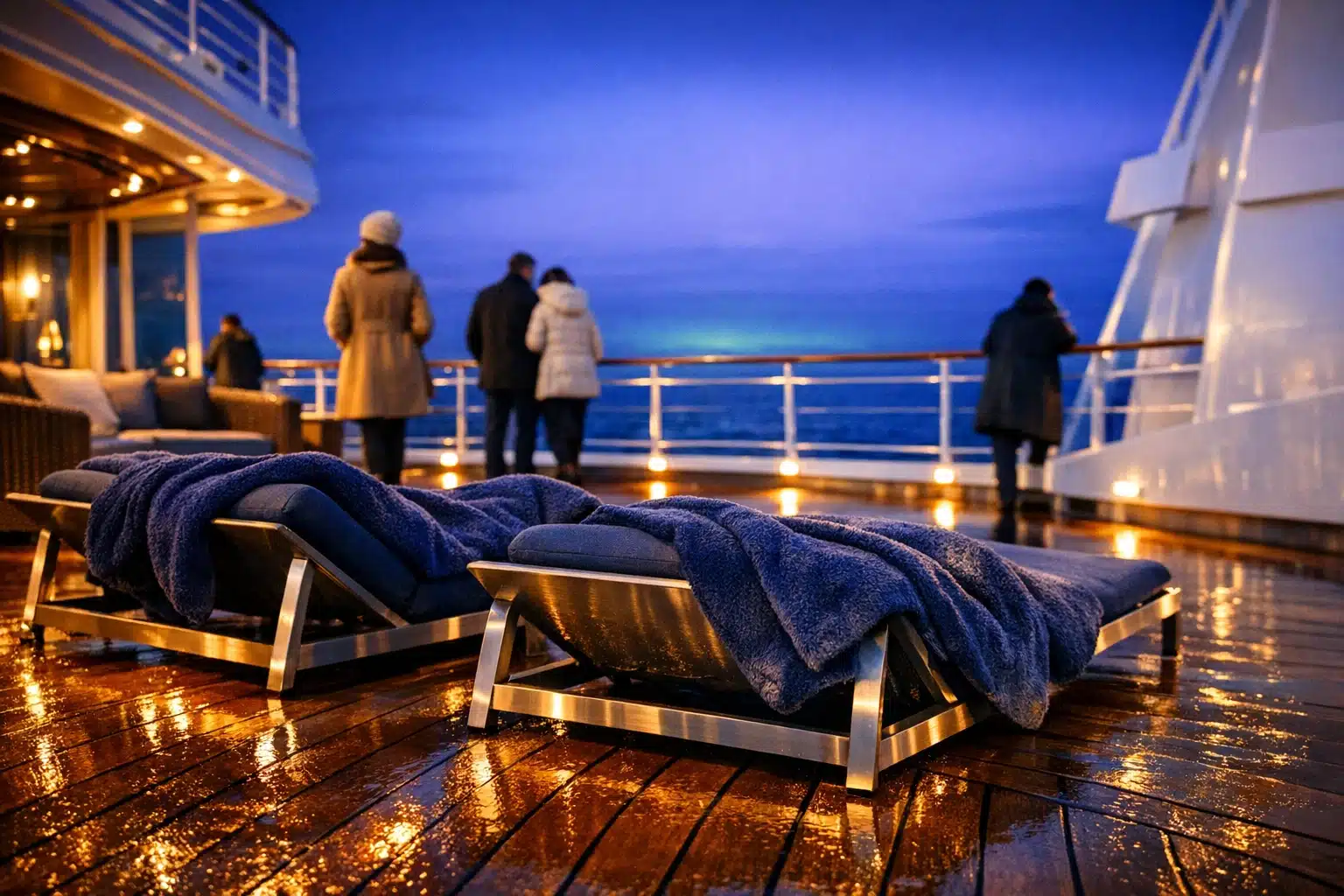
Winter conditions also shape the atmosphere. Decks can be windy, damp, and cold, with temperatures often dropping sharply after dark. That means passengers usually rotate between indoors and outdoors rather than standing outside for hours on end. It becomes a rhythm: step out, scan the horizon, feel the sting in your cheeks, return for a hot drink, then try again. In a strange way, that rhythm adds to the charm. The ship becomes a floating shelter for a shared vigil.
Food, comfort, and cabin choice play a larger role than on a destination-led itinerary. If seas are lively, a midship cabin on a lower deck may feel steadier than a higher forward cabin. If you value sleep, choosing a quieter location away from late-night venues can be wise. A balcony can be appealing, but on a cold short voyage many travellers end up using public decks more often, where views are wider and fellow passengers sometimes spot changes in the sky first. Think of the cruise less as a checklist trip and more as an experience of mood, motion, and observation. That mindset usually leads to the best time onboard.
Your Real Chances of Seeing the Northern Lights, and Why Expectations Matter
This is the section travellers need most, because marketing can make any aurora-themed trip sound more certain than it really is. A 2-night Northern Lights cruise from Dover can offer a chance of seeing the aurora, but it does not provide the same probability as a longer voyage farther north. The Northern Lights appear when charged particles from the sun interact with Earth’s magnetic field and atmosphere, producing visible light. That scientific process depends on solar activity, and your experience depends on additional factors such as latitude, darkness, cloud cover, and the ship’s position.
The biggest limitation is geographic. Dover departures start much farther south than classic aurora hotspots such as Tromso, Alta, or parts of northern Iceland. A short cruise simply does not have enough time to travel deep into the high Arctic. Therefore, visible displays generally require a stronger geomagnetic event or especially favourable conditions. That does not make sightings impossible; it just means the odds are less predictable and often lower than many passengers assume.
Several conditions need to line up:
- Skies must be dark enough, which is why winter sailings are preferred.
- Cloud cover must be limited, because even a strong display can be hidden.
- Solar activity must be sufficient for the aurora to extend to lower latitudes.
- The ship must be in a position with minimal light pollution and a clear horizon.
One useful comparison is with a land-based aurora trip in northern Scandinavia. There, travellers may spend several nights under statistically better skies and can move inland to avoid coastal cloud. On a 2-night cruise from Dover, you cannot drive to a clearer patch or add two extra evenings. You take the conditions as they come. That sounds restrictive, yet it also explains the emotional pull. If an aurora appears over the open sea on a short sailing from England, the moment feels wonderfully improbable, almost like the sky decided to improvise.
The right way to book this cruise is to value the possibility, not rely on the promise. Treat the aurora as a bonus rather than the sole product you are purchasing. If you want the highest realistic chance of seeing the lights, a longer trip farther north remains the stronger option. If you want a stylish winter break with a meaningful chance, however uncertain, then this short cruise can still make sense. Clear expectations protect enjoyment. Passengers who board believing the sky has signed a contract are often disappointed. Those who board for the overall experience tend to enjoy the voyage whether the heavens glow or remain quietly black.
Cost, Cabin Choices, Packing, and Practical Planning Before You Book
The practical side of a 2-night Northern Lights cruise from Dover deserves careful thought because short trips can seem cheap at first glance while quietly adding extras. The headline fare may look attractive compared with a week-long Arctic cruise, and in broad terms it usually is. Still, total cost depends on cabin category, dining upgrades, drinks, parking or rail travel to Dover, and optional spending onboard. A well-priced inside cabin can keep the break affordable, while a suite with premium packages can shift it into a very different bracket.
For many travellers, the smartest approach is to spend selectively. Because the itinerary is short and the focus is often on deck views and communal spaces, an inside or ocean-view cabin may offer better value than a balcony. On a warm Mediterranean cruise, a private outdoor space can transform the trip. On a cold winter North Sea sailing, some passengers discover that wind and darkness reduce balcony use more than expected. That does not make balconies pointless; it simply means the premium should be weighed against how you actually travel.
When planning, think in four categories:
- Transport to Dover: fuel, parking, rail fares, taxis, or a hotel the night before.
- Cabin and fare type: inside, ocean-view, balcony, or suite, plus flexible booking terms.
- Onboard spending: drinks, speciality dining, spa treatments, and Wi-Fi if needed.
- Cold-weather essentials: proper layers, gloves, hat, scarf, and shoes with good grip.
Packing is especially important. The ship may be warm inside, but aurora watching is a stop-start outdoor activity. You are not dressing for a city walk; you are dressing for standing still in sea wind after dark. Thermal base layers, a fleece or wool mid-layer, and a weather-resistant outer layer make a noticeable difference. Warm socks matter. Thin gloves that allow phone use are handy, but many people prefer layering them under thicker mittens. A small day bag, lip balm, and a power bank for your phone can also prove useful.
If you are prone to motion sickness, prepare before sailing rather than reacting after the ship starts moving. Winter seas can be lively. Medication, acupressure bands, ginger products, or a combination recommended by a pharmacist may help. Choosing a more central cabin can reduce the sensation of movement for some passengers. Finally, check what the cruise line includes in the fare. Some operators bundle more than others, and that affects value. The most satisfied travellers are usually those who budget realistically, dress properly, and understand that a short winter cruise rewards preparation more than impulse.
Conclusion: Who This Cruise Is Best For, and Who May Prefer a Different Trip
A 2-night Northern Lights cruise from Dover is best understood as a compact winter experience with a real, but limited, aurora opportunity. That description may sound modest, yet it is actually its strength. For travellers based in the UK who want an unusual short break, it offers convenience, atmosphere, and a memorable sense of occasion. You can board without international flights, settle quickly into holiday mode, and spend two nights chasing darkness across open water. If the sky cooperates, the reward can feel extraordinary. If it does not, the trip can still succeed as a distinctive sea escape.
This cruise is especially well suited to a few types of traveller. It works for curious first-time cruisers who want to test the format before committing to a longer itinerary. It suits couples who like the romance of winter decks and horizon views. It also fits busy professionals who cannot easily spare a week but still want something more story-worthy than a standard weekend in town. For photographers and passionate aurora chasers, it can be a fun gamble, though not the most efficient route to a sighting.
- Choose it if you value convenience, novelty, and the overall cruise atmosphere.
- Choose it if you can enjoy the voyage even without a guaranteed celestial display.
- Skip it if your main goal is maximizing aurora probability at almost any cost.
- Skip it if you dislike cold, wind, sea motion, or time spent waiting on uncertain weather.
Compared with longer sailings in Norway or dedicated land-based trips in the far north, the Dover option is less about certainty and more about accessibility. That distinction should guide your booking decision. If your dream is to give yourself the strongest possible statistical chance of seeing the Northern Lights, save for a longer trip farther north. If your dream is to turn an ordinary weekend into something darker, stranger, and more cinematic, this voyage has a strong case.
For the right traveller, that is enough. Not every great trip needs to be huge, remote, or meticulously productive. Sometimes the appeal lies in stepping aboard, watching England disappear, and waiting under a cold night sky for something beautiful that may or may not arrive. In that space between schedule and spectacle, this short cruise finds its identity. Book it for the full experience, not only for the headline, and you are far more likely to come home satisfied.