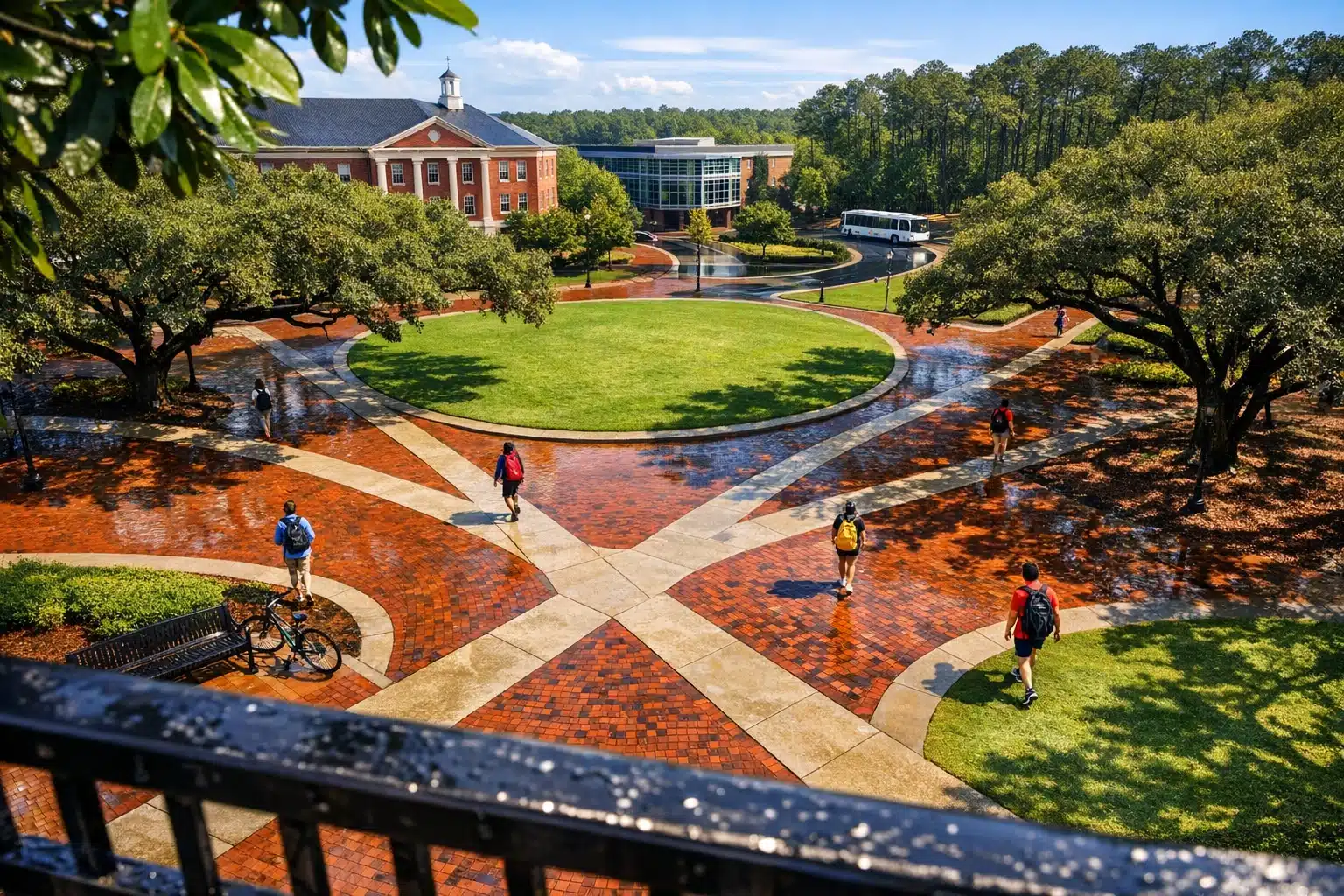
 Artificially generated image
 Affordable Colleges in Georgia, USA: A Practical Guide
In Georgia, the sticker price on a college brochure rarely tells the whole story. Public institutions, transfer-friendly pathways, and state aid programs can turn what looks expensive into something workable for families with tight budgets. The challenge is knowing where low tuition meets solid academics, practical majors, and realistic graduation paths. That is exactly where a careful comparison becomes more useful than a flashy ranking.
Understanding Affordability in Georgia and Article Outline
For many students, the college search begins with excitement and ends with a calculator. That is not a bad thing. In fact, affordability deserves a front-row seat in the decision-making process, because the “least expensive” school on paper is not always the one that costs the least by graduation day. In Georgia, this matters even more because the state offers a wide mix of options: public universities in the University System of Georgia, technical colleges, two-year campuses, regional institutions, and private colleges that sometimes reduce high sticker prices with merit aid. Looking only at published tuition can hide the real financial picture.
A useful way to think about affordability is to separate sticker price from net price. Sticker price includes published tuition and fees, and often estimates for housing, food, books, and transportation. Net price is what remains after grants and scholarships are applied. For in-state students, Georgia’s public colleges often become especially competitive because resident tuition is typically much lower than out-of-state tuition. A campus that looks average at first glance can become a strong bargain once state aid, federal grants, and lower living costs are factored in.
This article follows a practical outline so readers can compare schools with a clear head rather than just react to rankings:
- How affordability works in Georgia and why net price matters more than hype
- Which public colleges are often viewed as lower-cost choices for Georgia residents
- How housing, commuting, and major selection can change the total bill
- Which financial aid tools and savings strategies can shrink overall costs
- How students and families can choose a college that fits both budget and long-term goals
Another point worth stressing is that affordability is not only about low tuition. Time to degree matters. So do advising, class availability, transfer pathways, and retention support. A campus with slightly higher annual costs can still be the better value if students can graduate on time, find the courses they need, and move into employment or graduate study without delay. In other words, smart college shopping is less like bargain hunting at a clearance sale and more like building a solid travel plan: the cheapest ticket is not helpful if it sends you in the wrong direction.
As you read the sections that follow, keep one question in mind: what will this college likely cost me after aid, and what will it help me do next? That simple shift turns a confusing search into a practical decision.
Public Colleges in Georgia That Often Stand Out for Lower Costs
Georgia residents looking for affordable higher education usually start with public institutions, and for good reason. Many colleges in the state offer relatively manageable in-state tuition compared with national averages, especially when students attend regional campuses rather than large flagship universities. Exact tuition and fee figures change each academic year, so it is smart to verify every number on an official college cost page. Still, some names appear again and again in conversations about value because they combine lower published prices with practical degree paths.
Several Georgia schools are commonly mentioned as budget-friendly options:
- Georgia Highlands College, known for low-cost access, multiple locations, and strong transfer pathways into four-year programs
- South Georgia State College, which offers a smaller-campus feel and can appeal to students who want a lower-cost starting point
- Middle Georgia State University, a public university with career-oriented programs, online offerings, and comparatively accessible pricing
- Dalton State College, often appreciated for affordable bachelor’s options and a regional focus
- College of Coastal Georgia, which blends a traditional campus setting with an in-state price that many families find approachable
- Abraham Baldwin Agricultural College, noted for applied programs, a practical culture, and a cost structure that can be attractive for residents
What separates these colleges is not just price, but fit. Georgia Highlands College works especially well for students who want to begin with core coursework and transfer later. That can be a smart route for future business, education, or health science majors who do not need an expensive first year to prove they belong in college. Middle Georgia State University may suit students who want to stay price-conscious while still pursuing bachelor’s degrees in areas such as information technology, business, aviation-related fields, or public service. Dalton State College and the College of Coastal Georgia can appeal to students who want a four-year environment without the cost profile of a larger metro campus.
It is also worth noting that “affordable” can mean different things depending on where a student lives. A school with modest tuition may become much more expensive once room and board are added. That is why regional campuses near home can quietly outperform more famous names in total value. For a student who can commute, use existing family support, and avoid major relocation expenses, a public college in Georgia may offer one of the cleanest cost-to-opportunity ratios available.
Private colleges in Georgia deserve a brief mention as well. Their sticker prices are often much higher, but some offer strong merit scholarships or institutional grants. For certain students, especially those with strong academic records, the final net price can end up surprisingly competitive. The lesson is simple: compare actual aid offers, not just the number printed in the catalog.
Beyond Tuition: Housing, Location, and Program Choice Can Change the Real Cost
One of the biggest mistakes families make is treating tuition as the whole bill. In reality, tuition is only one piece of college cost. Housing, meal plans, transportation, books, technology fees, and personal expenses can easily reshape the final number. In some cases, a school with low tuition becomes expensive because students must live on campus or travel long distances. In other cases, a college with slightly higher tuition becomes more manageable because a student can commute, work part time, or use online classes to reduce daily costs.
Georgia offers a good example of how location influences value. A campus in or near a major urban area may provide stronger internship access, public transportation, and more job opportunities during the academic year. That can help students earn income and build experience. At the same time, living costs in larger metro areas are often higher. By contrast, a college in a smaller town may have lower housing costs and a calmer pace, but fewer nearby employers and less flexibility for commuters. Neither model is automatically better. The right answer depends on the student’s academic needs, financial situation, and tolerance for travel time.
Program choice matters just as much. Some majors naturally cost more because they require labs, equipment, licensure preparation, or clinical placements. Nursing, aviation, engineering technology, art and design, and some science-heavy programs may include extra expenses beyond standard tuition. That does not make them bad choices; it simply means students should plan more carefully. A low-cost campus is only truly affordable if it offers the major a student wants, or at least a clear transfer route into that major.
Here are a few practical questions that often reveal the true cost of attendance:
- Can I live at home and commute without hurting my academic schedule?
- Does this college offer my intended major, or will I need to transfer later?
- Are online or hybrid classes available to reduce travel and housing costs?
- What extra fees apply to my program, labs, software, or equipment?
- How long do students in my major typically take to graduate?
Think of it this way: a cheap campus two hours away can become expensive the moment dorm charges walk into the room. Meanwhile, a nearby college with a reliable transfer plan can save thousands while keeping momentum intact. The most affordable college is not simply the one with the lowest tuition line. It is the one that lets a student finish a useful credential with the fewest financial detours.
Financial Aid, Scholarships, and Cost-Saving Strategies for Georgia Students
If affordable colleges are the map, financial aid is the bridge. Georgia students have several tools that can reduce college costs significantly, especially when they combine state aid, federal support, and personal planning. The most important first step is straightforward: complete the FAFSA as early as possible. That single form can determine eligibility for federal Pell Grants, federal student loans, work-study opportunities, and in many cases institutional aid. Students who delay this step sometimes miss out on funding that could have changed their final choice.
Georgia is especially known for state scholarship programs tied to academic performance. The HOPE Scholarship has long been a major factor for eligible Georgia residents attending in-state colleges, and the Zell Miller Scholarship can provide even stronger support for students who meet higher academic thresholds. Rules can change, and eligibility depends on factors such as residency and academic record, so students should always review the current requirements through official state and college sources. Still, these programs are among the clearest reasons Georgia can be a financially sensible state for college-bound residents.
There are other helpful tools as well. Students considering private colleges may want to look at the Georgia Tuition Equalization Grant, which can reduce costs at eligible private institutions. Federal Pell Grants are especially important for lower-income students because, unlike loans, grants do not require repayment. Colleges themselves may also award merit scholarships, need-based grants, talent awards, or departmental aid for specific majors.
Cost-saving strategies often work best when stacked together:
- File the FAFSA early and keep all requested documents organized
- Apply for state scholarships and verify renewal requirements each year
- Compare net price calculators before applying broadly
- Consider starting at a lower-cost campus and transferring through an approved pathway
- Use AP, IB, dual enrollment, CLEP, or transfer credit where accepted
- Buy used textbooks, rent digital versions, or use library copies when possible
- Choose housing carefully, since room and board can exceed tuition at some colleges
Students should also pay attention to renewal rules. A scholarship that looks generous in year one is only helpful if it can be maintained. GPA thresholds, credit-hour requirements, and satisfactory academic progress standards matter. Another smart move is to ask colleges about payment plans, emergency aid funds, and work opportunities on campus. Small details can make a real difference over several semesters.
Money conversations are rarely glamorous, but they are deeply empowering. When students understand how aid works, they stop seeing college prices as fixed walls and start seeing them as negotiable landscapes with multiple paths across.
Final Thoughts for Students and Families Choosing an Affordable College in Georgia
The search for an affordable college in Georgia is really a search for balance. Students are not only choosing a campus; they are choosing a financial model, a learning environment, and a path into adult life. A low-cost college that offers the right major, dependable advising, and a realistic graduation timeline can be far more valuable than a more famous school that stretches the budget and delays completion. For first-generation students, adult learners, transfer students, and families managing multiple priorities at once, that balance is not a luxury. It is the main event.
A practical decision usually starts with a short list rather than a giant one. Compare schools by net price, not just tuition. Review whether each college offers the intended major or a clean transfer route. Look at graduation support, class availability, internship access, and commuting feasibility. If possible, visit campus or attend a virtual information session. A school can look efficient on paper and still feel wrong in person. The reverse is also true: a modest regional college may turn out to be exactly the place where a student can focus, save money, and move forward with confidence.
As a final checklist, students and families should ask:
- What will this college likely cost after grants and scholarships?
- How much debt would I need to take on each year?
- Can I complete my program on time here?
- Does this campus support my academic goals and day-to-day life?
- Would a transfer pathway or commuter plan lower the cost without hurting the outcome?
Georgia offers more affordable routes to a degree than many people assume. Regional public colleges, lower-cost starting points, technical and transfer options, and strong state aid programs create real opportunity for students who plan carefully. The best choice will not be identical for everyone, and that is a good thing. Some students need a small campus close to home. Others need a bachelor’s program with online flexibility. Some want the lowest possible upfront cost, while others are willing to pay slightly more for stronger program alignment.
The key takeaway is simple: affordability should be measured by the full journey, not the first number you see. If you compare net price, ask better questions, and match cost with purpose, Georgia can offer a college path that is both financially sensible and academically worthwhile.