 Artificially generated image
 Sewing Classes for Beginners in 2026
In 2026, beginner sewing classes matter for more than learning how to stitch a straight line. They give new makers a practical way to repair clothes, personalize their wardrobe, reduce textile waste, and build a skill that feels useful almost immediately. With lessons now available in studios, fabric shops, colleges, and live online spaces, access is no longer the main obstacle. The real task is finding a course, teacher, and pace that match your schedule, budget, and confidence level.
Outline: this article begins with why sewing is especially relevant for beginners in 2026, then compares the main class formats now available. It moves on to the real costs of tools and materials, explains what a strong beginner curriculum should include, and ends with practical advice for choosing a class and staying motivated long enough to enjoy real progress.
Why Sewing Classes Still Matter for Beginners in 2026
Sewing has always been a practical craft, but in 2026 it carries a different kind of weight. For many beginners, it is no longer only about making garments from scratch. It is about learning how to hem trousers that are too long, repair a torn seam instead of replacing a whole shirt, or alter a thrifted jacket so it finally fits. Rising interest in clothing longevity, personal style, and home-based creative hobbies has made sewing more relevant than it may have seemed a decade earlier. A beginner class offers structure at the exact moment when curiosity can easily collapse into confusion.
That structure matters because sewing looks deceptively simple from the outside. A short video can make threading a machine seem effortless, but a new student quickly learns that fabric choice, seam allowance, tension, pressing, and accurate cutting all affect the final result. One crooked first seam is rarely the real problem; the problem is usually a chain of small misunderstandings. Classes help untangle that chain. A good teacher can see, within seconds, whether the issue comes from the needle, the bobbin, the way fabric is being guided, or the student simply sewing too fast. That kind of feedback is difficult to get from scattered tutorials.
There is also a strong economic argument for classes. Even basic clothing repairs can save money over time, especially for households that would otherwise pay for alterations. Learning to shorten curtains, replace a zipper, mend children’s clothes, or reshape secondhand finds turns sewing into a life skill rather than a passing hobby. For some beginners, it also becomes a gateway to micro-business ideas such as simple commissions, custom home décor items, or craft market products. Not every student wants that outcome, but the option exists once the core skill is built on solid ground.
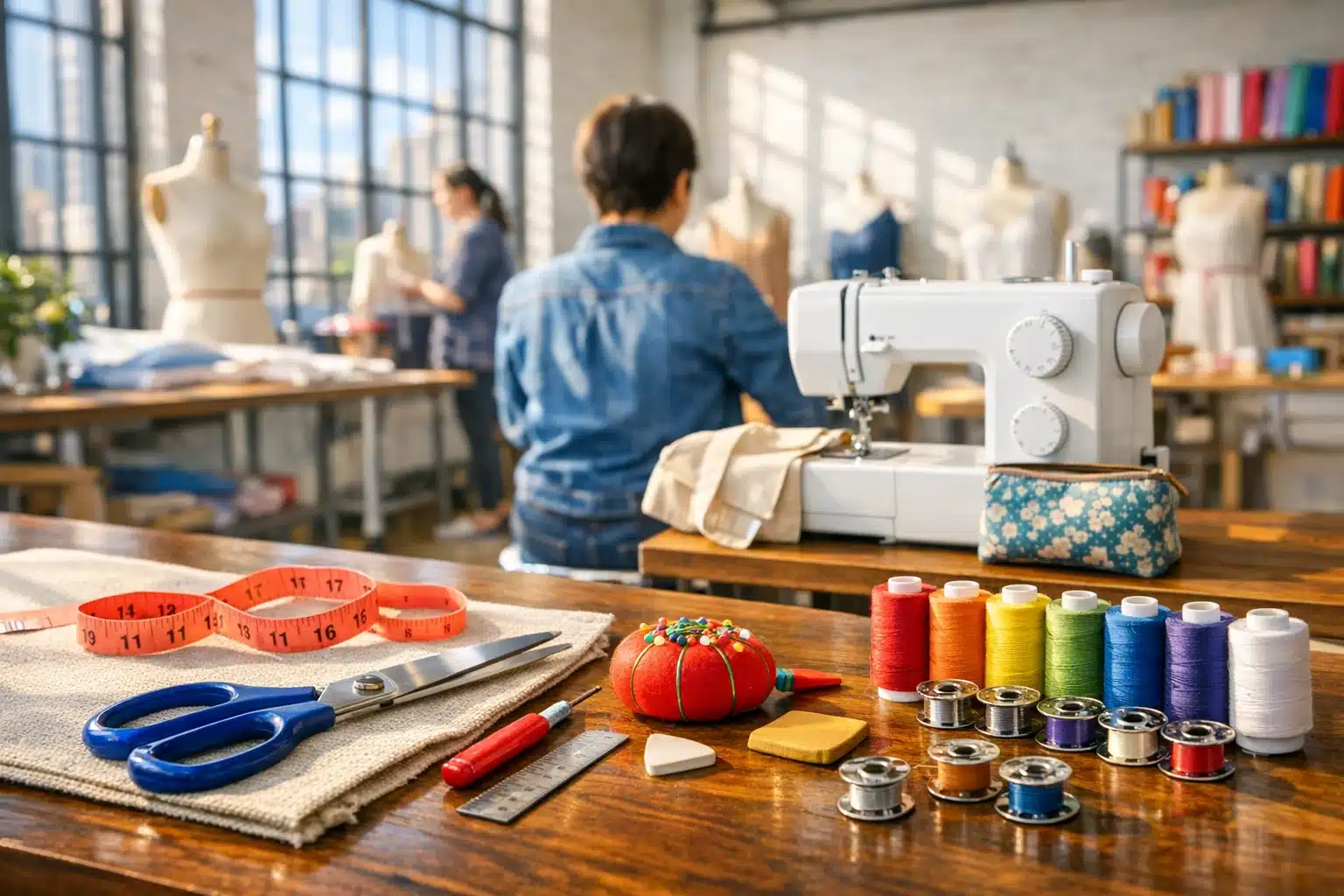
Just as importantly, sewing classes create a calmer learning environment than endless online searching. A sewing room often sounds less like industry and more like possibility: scissors on the table, chalk marks on cotton, and the steady hum of a machine turning uncertainty into something wearable. In 2026, when so many skills are picked up through fragmented digital content, a well-planned beginner class still stands out because it teaches sequence, patience, and problem-solving. Those qualities matter as much as the finished project. For a beginner, the class is not only about making an apron or tote bag. It is about learning how to think like a sewer, one deliberate step at a time.
Comparing the Main Types of Sewing Classes Available to Beginners
Beginners in 2026 can choose from more class formats than ever before, and each one suits a different kind of learner. The most traditional option is the in-person local class offered by a fabric shop, sewing studio, community center, or adult education program. These classes are often the easiest starting point because they combine hands-on demonstration with direct correction. If your machine jams, your teacher can fix it. If your corners look bulky or your seam allowance drifts, someone can point it out before the mistake spreads through the whole project. For absolute beginners, this immediate intervention is often the biggest advantage of learning in person.
Community college or adult education courses usually move at a steadier, more methodical pace. They may run for several weeks and often spend more time on terminology, machine basics, fabric behavior, and safe habits. Local sewing shops, by contrast, sometimes focus on project-based classes with a faster payoff, such as making a tote bag, pajama shorts, or a zip pouch. Neither model is automatically better. The difference is mostly about learning style. A student who wants a broad foundation may prefer a term-based course, while a student who needs early success might benefit from a short project class that builds confidence quickly.
Online learning has become much more sophisticated by 2026, especially in live workshop formats. A live virtual class can be a strong choice for students in rural areas, busy parents, or anyone who wants to learn from a specialized teacher without traveling. Good online classes often use overhead cameras, downloadable notes, and small-group question time. Still, they have limitations. A teacher cannot physically rethread your machine, feel the grain of your fabric, or spot every detail of how you are holding the material. Pre-recorded courses are even more flexible, but they demand self-discipline and often leave beginners alone when a simple technical glitch blocks progress.
A practical comparison looks like this:
• In-person group classes: best for hands-on feedback, community, and machine troubleshooting.
• Private lessons: best for rapid progress and custom goals, but usually cost more per hour.
• Live online classes: best for convenience and access to niche teachers, with moderate feedback.
• On-demand courses: best for low-cost flexibility, but weakest for real-time correction.
• Maker spaces and sewing clubs: best for community practice, though instruction quality may vary.
The right choice depends less on what sounds impressive and more on what removes friction from learning. If commuting exhausts you, an excellent local studio may still become a bad fit. If you freeze when asking questions in groups, a cheaper class may feel expensive if you leave every session confused. Beginners do best when the format matches their habits, not just their ambitions.
Budget, Equipment, and Materials: What Beginners Really Need
One of the biggest barriers for new students is the fear that sewing requires a large upfront investment. In reality, beginners can start sensibly if they separate essentials from upgrades. A common mistake is buying too much too soon: expensive scissors for every task, stacks of novelty fabric, specialty feet, pattern bundles, and a machine loaded with features that will not be used for months. The smarter approach is to build a basic toolkit that supports learning without making the hobby feel financially heavy from day one.
For most beginner classes, the essential tools are fairly simple. Students typically need fabric scissors, pins or clips, a seam ripper, measuring tape, chalk or marking tools, hand needles, thread, and a small ruler or gauge. If the class requires a machine, the most beginner-friendly choice is often a reliable mechanical model with a straight stitch, zigzag stitch, adjustable stitch length, and easy bobbin access. Computerized machines can be excellent, but they also introduce menus, extra settings, and repair costs that some new learners do not need immediately. If a class provides machines, that can be a major cost saver and a very good reason to try in-person learning before buying anything large.
Fabric and project selection also affect the budget more than many people expect. Stable woven cotton is usually easier for beginners than slippery satin, stretchy knits, or thick upholstery fabric. A student trying to learn seam accuracy on difficult material may blame themselves for problems caused by the textile. Good teachers know this and often choose projects that keep frustration low. Costs commonly rise through small add-ons:
• extra bobbins and needles
• cutting mats and rotary cutters
• pattern printing or tracing supplies
• zippers, elastic, interfacing, and buttons
• class kit fees or machine maintenance
It is worth asking in advance whether a course includes materials, because pricing can be misleading. A less expensive class may require students to buy everything separately, while a slightly pricier workshop might include fabric, notions, machine use, and printed instructions. That difference changes the real value dramatically. Beginners should also factor in practice costs. Sewing improves through repetition, and repetition uses fabric, thread, and time.
The best budget strategy in 2026 is not to chase the cheapest route or the fanciest setup. It is to spend where mistakes become easier to understand. A sharp pair of scissors matters. The right needle matters. A clear teacher matters most of all. When a beginner buys tools that support learning rather than tools that promise perfection, sewing becomes far more welcoming. You do not need a dream studio to begin. You need a clean table, a workable plan, and enough patience to let skill catch up with enthusiasm.
What a Strong Beginner Sewing Curriculum Should Actually Teach
Not all beginner classes teach the same things, and that difference matters more than the class title suggests. A strong beginner curriculum should do more than walk students through one cute project. It should build transferable skills that work beyond the classroom. If a student finishes a course with a drawstring bag but still cannot thread a machine, identify the fabric grain, or understand why a seam puckered, then the class may have been enjoyable without being foundational. Good teaching balances immediate results with repeatable knowledge.
The first stage of a solid curriculum usually focuses on machine confidence and basic control. Students should learn the function of the needle, presser foot, bobbin, feed dogs, stitch length, and backstitching. They should understand how to wind and insert a bobbin correctly, when to change a needle, and how to sew slowly enough to remain accurate. Basic pressing should appear early as well, because ironing seams during construction is one of the most overlooked parts of neat sewing. A garment rarely looks polished by accident. It usually looks polished because the maker pressed at the right moments, trimmed bulk, and followed order carefully.
After the setup basics, the class should introduce materials and construction. This includes reading the selvedge, recognizing common woven fabrics, cutting on grain, pinning or clipping properly, and maintaining a consistent seam allowance. From there, beginners benefit from learning a few core techniques:
• straight seams and pivoting corners
• topstitching and edge finishing
• simple hems
• inserting elastic
• attaching basic closures such as buttons or beginner-friendly zippers
• reading pattern symbols and layout markings
Project choice is a revealing sign of class quality. Some projects look impressive on social media but are poor teaching tools for first-timers. A good first project is usually simple, forgiving, and skill-focused. A tote bag teaches seam construction and handles. A pillowcase teaches hems and straight edges. Elastic-waist shorts introduce garment logic without the pressure of advanced fitting. A zip pouch adds precision and closure practice. The best classes sequence these projects so each one adds one or two new skills rather than six at once.
Finally, a useful curriculum should teach troubleshooting, because beginners do not quit only from complexity; they quit from small repeated frustrations. Students need to know what to do when thread nests under the fabric, stitches skip, seams wave, or the machine suddenly sounds wrong. In many ways, this is where confidence is truly built. Sewing stops feeling like magic and starts feeling understandable. That moment is powerful. The student realizes that mistakes are not proof of failure. They are signals, and signals can be read.
A Practical Conclusion for Beginners: How to Choose the Right Class and Keep Going
If you are new to sewing in 2026, the best class is not the one with the trendiest photos or the longest tool list. It is the one that helps you return for the second lesson feeling curious rather than defeated. Beginners often overestimate how much speed matters and underestimate how much teaching style matters. A patient instructor with a clear sequence can save weeks of frustration. Before enrolling, look beyond the course title and ask direct questions. Does the class welcome complete beginners? Are machines provided? How many students are in each session? Will you leave with notes or a pattern you can use again? Is the goal technique, project completion, or both?
Reviews can help, but they should be read carefully. Praise such as “fun class” is useful only when paired with clues about instruction quality. Look for comments about pacing, clarity, and whether students received individual help. Smaller groups often give beginners a better chance to ask questions without feeling rushed. If you are choosing between online and in-person learning, think honestly about your habits. Do you usually finish self-paced courses, or do you need scheduled accountability? Do you learn better by watching twice, or by having someone stand beside you when the machine misbehaves?
Once you start, progress comes from consistency more than intensity. A beginner who sews for thirty focused minutes three times a week often improves more steadily than someone who attempts an exhausting six-hour weekend marathon once a month. Keep your first goals modest and concrete. Learn to sew straight. Learn to press seams properly. Learn to unpick without panic. Small wins are not small in sewing; they are the foundations that make later projects possible.
A few habits make the journey easier:
• keep a notebook with needle sizes, machine settings, and fabric observations
• save test swatches from practice sessions
• repeat one useful project before jumping to a harder one
• budget for mistakes, because every beginner makes them
• choose fabrics that cooperate while your hands are still learning
For the target audience of this article, the message is simple. You do not need natural talent, a designer label machine, or a studio full of supplies to begin well. You need guidance that makes sense, projects that teach in the right order, and enough room to learn without embarrassment. The first time you turn flat fabric into something functional, the result feels quietly remarkable. That is why sewing classes remain worth considering in 2026. They do more than teach a craft. They give beginners a practical skill, a creative outlet, and a satisfying reason to keep making things with their own hands.