 Artificially generated image
 Space-Saving Pools Explained: Costs, Designs, and Options for Small Gardens
A small garden does not cancel the dream of a pool; it simply turns the project into a smarter puzzle. When every square meter matters, choices about footprint, access, depth, filtration, and safety become more important than flashy extras. The encouraging part is that modern plunge pools, narrow lap pools, spools, and modular shells can fit into spaces that traditional pool plans would ignore. This guide breaks down costs, layouts, and planning decisions so a compact yard can still deliver a satisfying place to swim, cool off, or unwind.
Outline:
- What space-saving pools are and which compact formats are most common.
- How installation, running costs, and hidden expenses affect the total budget.
- Which design choices make a small pool feel visually larger and more useful.
- What pool options work best for courtyards, narrow plots, and modest back gardens.
- How homeowners can choose a realistic solution that matches lifestyle, site limits, and long-term upkeep.
What Counts as a Space-Saving Pool?
A space-saving pool is not just a smaller version of a standard backyard pool. It is a pool designed around restricted dimensions, tighter access, and a more deliberate balance between leisure and practicality. In many residential projects, that means using a footprint that may range from roughly 2 by 3 meters for a compact plunge pool to about 2.5 by 8 meters for a narrow lap design. Those numbers vary by region and builder, but the underlying idea stays the same: preserve outdoor living space while still creating a place to cool down, exercise lightly, or relax after work.
Several formats sit under this compact-pool umbrella. Plunge pools are usually the most recognizable. They are built for soaking, gentle movement, and temperature control rather than full-length swimming. Spools, a blend of spa and pool, often add jets and heating, making them useful across more seasons. Narrow lap pools prioritize movement and are ideal for long, slim gardens where width is limited but length is available. Swim spas and current pools use resistance jets to simulate endless swimming in a smaller vessel, which can be a strong option for fitness-minded homeowners who cannot dedicate space to a full lap lane.
Compact pools appeal for reasons beyond size. They often require less water, less chemical treatment, and less heating energy than larger installations. That does not automatically make them cheap, because a small custom concrete pool can still involve excavation, retaining walls, drainage, engineering, and premium finishes. Yet they can be more efficient in daily use. A household that wants a place to dip in summer may get far more value from a 4-meter plunge pool than from a large basin that dominates the entire yard and sits half-used for much of the year.
The limitations matter too. A space-saving pool will not satisfy every goal. Families expecting active games, diving, or several swimmers at once may find the experience cramped. Storage for equipment can also become more important in a tiny outdoor area, as pumps, covers, and accessories compete with seating, planting, and pathways. The best compact pools succeed because they are honest about purpose. They do one or two jobs very well, and they let the garden keep breathing instead of turning it into a construction afterthought.
Costs: Installation, Running Expenses, and Hidden Budget Traps
The price of a space-saving pool can surprise people, largely because reducing the footprint does not reduce every other cost in equal proportion. Excavation crews still need access. Electrical work still has to be installed safely. Filtration, pumps, drainage, and compliance requirements do not disappear simply because the pool is shorter. In many markets, a basic above-ground or modular compact pool may start somewhere around 10,000 to 30,000 USD, while a prefabricated in-ground plunge pool often lands in a broader range such as 25,000 to 60,000 USD once site preparation is included. A custom concrete compact pool can easily rise to 50,000 USD and far beyond, especially where labor rates, engineering, or premium finishes are high.
Material choice plays a major role. Fiberglass or factory-made shells can reduce construction time and sometimes control costs, but delivery and crane access may add expense if the site is difficult. Concrete offers shape flexibility and a tailored finish, yet it is usually the most expensive route because it requires more labor and longer build time. Steel-sided or container-style solutions may appeal to buyers seeking a modern look or faster installation, but they still need a proper base, filtration, and local approval.
Homeowners should also budget for the less glamorous parts of the project. Common cost drivers include:
- Excavation and soil removal
- Retaining walls or structural support near boundaries
- Access constraints that require small machinery or manual labor
- Electrical upgrades for pumps, heaters, and lighting
- Heating systems such as heat pumps, gas heaters, or solar assistance
- Pool covers, fencing, and safety compliance
- Landscaping repairs after construction is complete
Running costs deserve equal attention. A compact pool often uses less water and fewer chemicals than a large family pool, but heating can still be significant, especially if the owner wants a spool-like experience from spring through autumn. Electricity costs vary by climate, insulation quality, cover use, and how often the pool is heated. Filtration and circulation are ongoing expenses, as are water testing, cleaning tools, and occasional servicing. In cooler climates, an uncovered heated plunge pool can quietly become the most expensive part of the garden.
The smartest budget approach is to think in layers rather than chasing a single headline price. Ask for a shell price, then a siteworks price, then a compliance price, then an equipment price, and finally an allowance for decking and planting. That method reveals whether a “good deal” is truly affordable. A compact pool can be financially sensible, but only when the quote reflects the whole journey, not just the shiny blue destination.
Design Choices That Make a Compact Pool Feel Bigger Than It Is
Small pools live or die by design. In a generous garden, a weak layout can be disguised by extra lawn, wider paving, or room for decorative features. In a tight courtyard or modest backyard, every line is visible. The pool, the coping, the planting, the seating, and the circulation routes all sit under the same spotlight. That is why successful space-saving pools are rarely accidents. They are carefully arranged compositions where shape, material, and sightline work together.
One of the strongest decisions is geometry. Rectangular pools usually make the most of limited space because they align neatly with walls, fences, and paving grids. Curved designs can look soft and inviting, but in a small plot they often waste usable edge space and make furniture placement harder. A narrow rectangle, by contrast, can double as a visual corridor, drawing the eye outward and making the garden feel longer. It is the landscape equivalent of a well-placed mirror in a compact room.
Depth is another overlooked design tool. Many compact pools do not need deep ends, and shallower water can improve comfort, reduce water volume, and simplify construction. Built-in benches, tanning ledges, corner steps, and perimeter seating also make the pool more usable without enlarging it. Instead of treating seating as an add-on, good designers often fold it into the water itself. That approach can turn a 3 by 4 meter pool into a social space rather than a decorative basin.
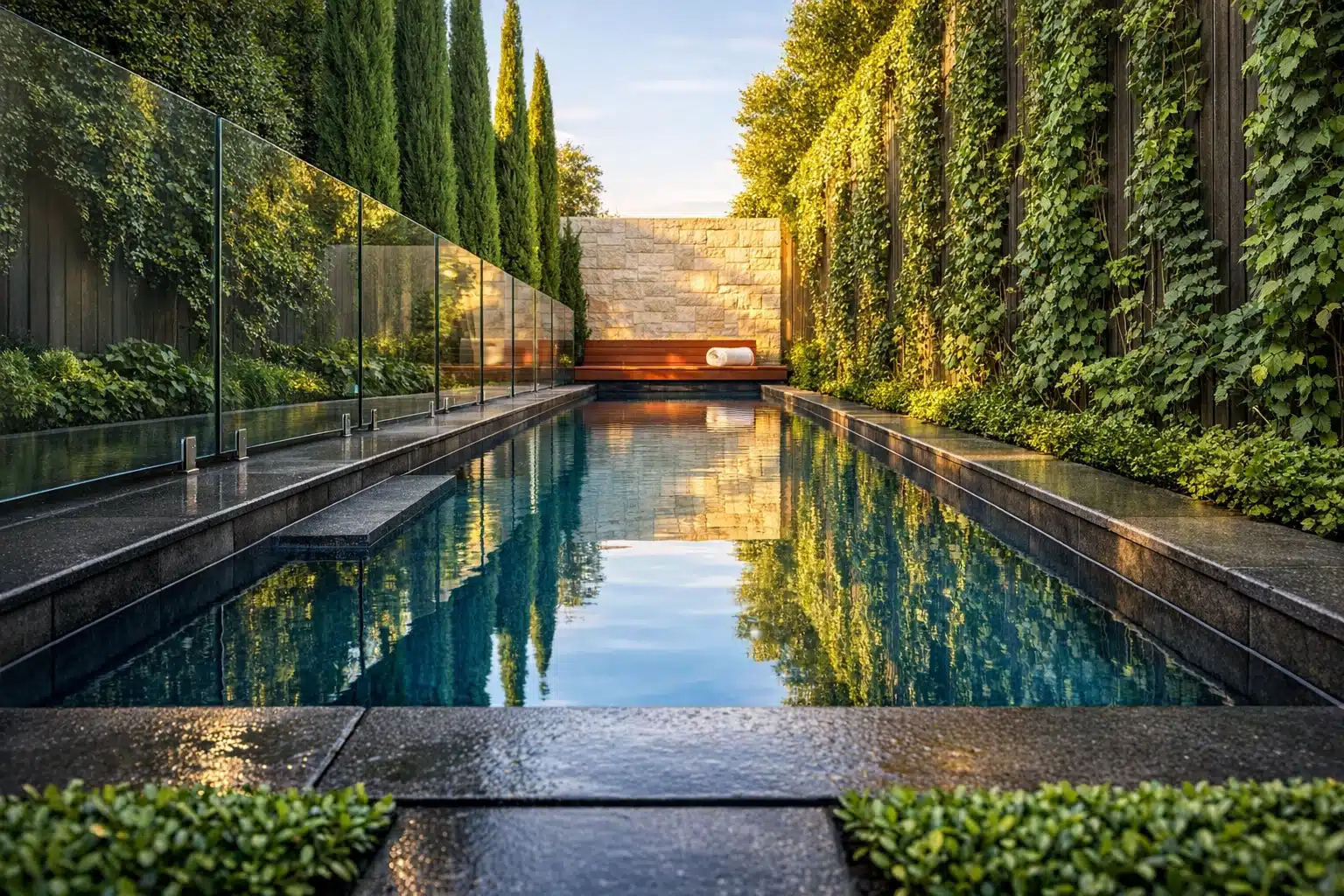
Materials strongly influence perceived size. Light interior finishes tend to brighten the water and create a more open appearance, while dark finishes can feel dramatic and reflective, particularly in urban courtyards. Coping and decking should usually be restrained. Too many colors, textures, or level changes make a tight garden feel busy. Repeating one paving material from house threshold to pool surround often creates calm continuity. Frameless glass fencing, slim planting beds, and integrated storage also help reduce visual clutter.
Useful design tactics include:
- Keep walkways clear so the pool does not block movement through the garden.
- Use planting vertically with screens, climbers, or slender trees instead of bulky shrubs.
- Choose one or two focal points, such as a water blade or feature wall, rather than several competing ornaments.
- Add an automatic cover if possible, as it improves safety, heat retention, and visual neatness.
- Plan nighttime lighting early so cables, controls, and fittings are integrated cleanly.
Perhaps the most important design principle is honesty about use. If the pool is for evening relaxation, build for comfort and atmosphere. If the goal is exercise, preserve a clean swim lane. If children will use it daily, prioritize entry points, durable surfaces, and supervision sightlines. A compact pool can feel luxurious, but its real magic lies in precision. Like a cabin on a well-designed boat, it proves that limited square footage can still feel generous when every detail earns its place.
Best Options for Small Gardens: Comparing Plunge Pools, Spools, Lap Layouts, and Modular Solutions
The best pool for a small garden depends less on trend and more on the shape of the site, the household routine, and the level of disruption the owner is willing to accept. A square courtyard might suit a plunge pool beautifully, while a long narrow townhouse garden may almost beg for a lap channel. Comparing the main options side by side helps reveal which trade-offs are worth making.
Plunge pools are often the most versatile choice for compact homes. They fit a modest footprint, can be heated, and support casual use from a single bather up to a small family. For readers who want a cooling pool rather than a sports facility, this is usually the first format to consider. Spools go a step further by blending pool and spa functions. They can be attractive where owners want year-round soaking and hydrotherapy-style features, but higher heating use may push up operating costs if the water is kept warm regularly.
Narrow lap pools make sense when exercise matters and the garden offers length more than width. Even a width of around 2 to 2.5 meters can work for steady stroke swimming if the line is unobstructed and steps do not intrude too heavily. These pools often look elegant because their proportions create a strong architectural axis. The compromise is that they are less social for lounging and may leave less room for broad entertaining zones beside them.
Modular and prefabricated options deserve serious attention in tight-access neighborhoods. Fiberglass plunge pools, panel systems, and some container-based designs can reduce construction time compared with fully custom builds. They may also minimize weather delays and simplify quality control because much of the shell is produced off-site. However, limited crane access, overhead wires, or terraced land can erase some of those advantages. A prefab unit is convenient only if it can actually reach the garden.
Other practical choices include:
- Above-ground or semi-inground pools with decking, which can lower excavation needs and sometimes suit sloped sites.
- Swim spas, which offer compact fitness potential and often install faster than in-ground pools.
- Courtyard dipping pools, ideal for heat relief and aesthetic value where outdoor space is minimal.
Before choosing, homeowners should study the site with almost ruthless realism. Key questions include whether excavation machinery can enter, whether neighboring structures are close to the dig zone, how far the equipment pad must sit from the pool, and what local fencing or barrier rules apply. Noise from pumps matters in dense urban settings. Sun exposure matters too, because a shaded pool can feel cold and underused even in a warm climate. In the end, the best option is not the fanciest or the most photogenic. It is the one that fits the garden physically, functions well through the seasons, and leaves enough surrounding space for the yard to remain enjoyable when no one is in the water.
Final Thoughts for Homeowners Planning a Small-Garden Pool
If you are weighing a pool for a compact garden, the smartest move is to think like both a dreamer and an editor. The dreamer sees summer evenings, reflective water, and a private place to reset after a long day. The editor trims what does not belong, asks what the pool must actually do, and protects the rest of the outdoor space from being swallowed by a single feature. That combination usually leads to better decisions than chasing the biggest design that can technically fit.
For most homeowners, the strongest starting point is a shortlist based on daily use. A plunge pool suits cooling off and relaxed social time. A spool suits buyers who value warm-water comfort and are ready for higher heating demand. A narrow lap pool suits exercise-oriented households with long, lean plots. A modular or prefab solution suits projects where build speed and predictable manufacturing matter, provided access is workable. None of these choices is universally best; each becomes sensible only when matched to the realities of the property.
A helpful final checklist looks like this:
- Define the main purpose: relaxation, exercise, family use, visual appeal, or mixed use.
- Set a full budget that includes construction, compliance, landscaping recovery, and yearly upkeep.
- Measure the garden with circulation, furniture, and maintenance access in mind, not just pool dimensions.
- Confirm local rules for fencing, drainage, setbacks, and equipment placement.
- Ask builders for itemized quotes so hidden costs are visible early.
- Consider future effort: cleaning, heating, cover handling, and seasonal care.
The audience most likely to benefit from a space-saving pool is not necessarily the household with the tiniest yard, but the one with the clearest priorities. A modest garden can host a beautiful and useful pool when the design is disciplined, the budget is realistic, and the pool type fits the way people truly live. In practical terms, that means choosing quality over size, efficiency over excess, and thoughtful planning over impulse. When handled well, a compact pool does more than save space. It turns overlooked corners and constrained plots into places with rhythm, comfort, and a little sparkle at the end of the day.