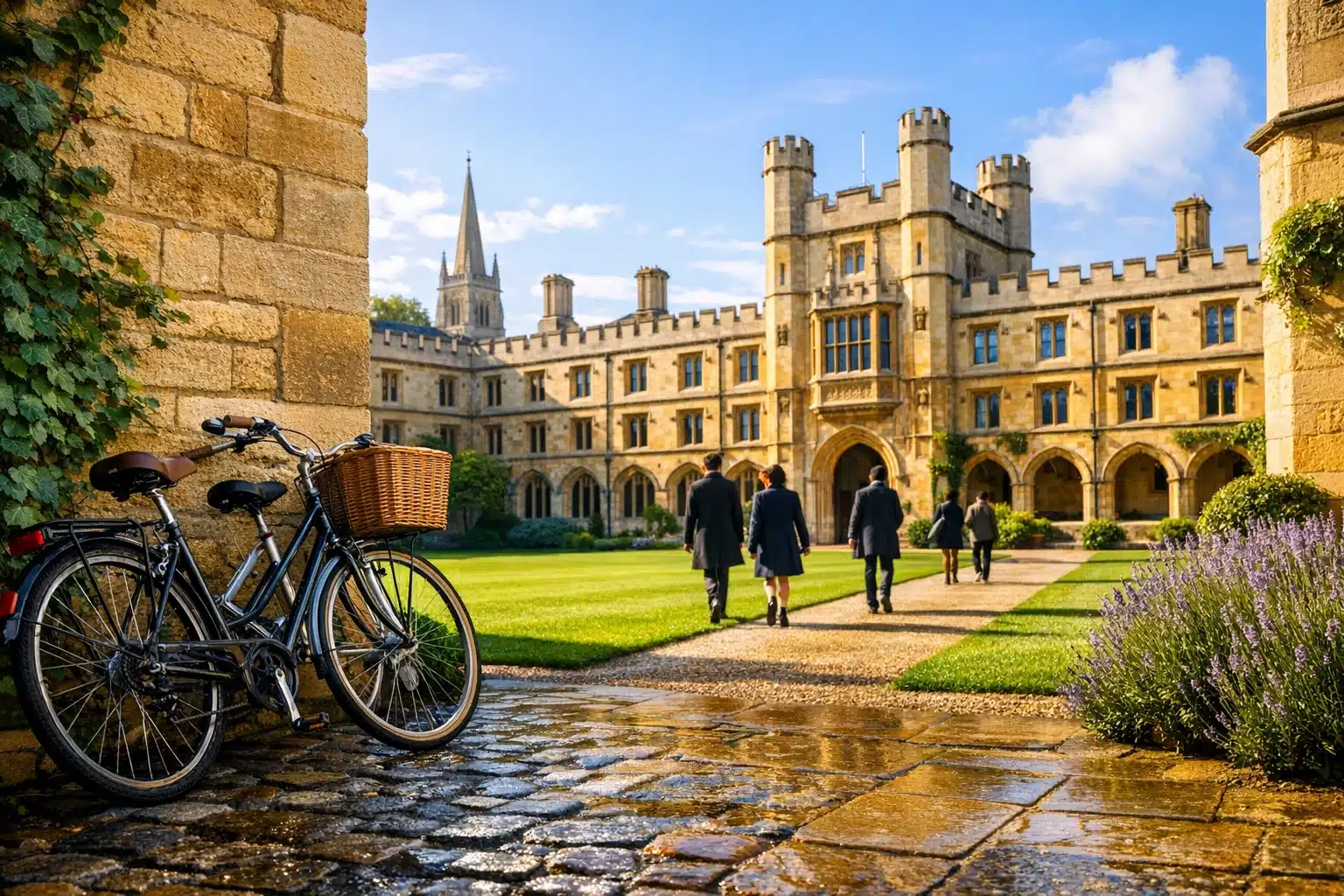
 Artificially generated image
 The Top Ranked Universities in the UK for 2026
Choosing a university in the UK has never been a simple numbers game, and the 2026 picture makes that even clearer. Rankings still matter because they influence reputation, research visibility, employer attention, and, for many international applicants, the first shortlist. Yet a league table cannot reveal whether a department matches your ambitions, whether a campus feels alive, or whether a city suits your budget. This guide sorts the leading names, explains why they score so highly, and helps you read the tables with better judgment.
Article Outline
- How UK university rankings for 2026 are built and why the same institutions appear repeatedly near the top.
- Why Oxford and Cambridge continue to set the pace in academic prestige, teaching style, and research depth.
- How London universities such as Imperial, UCL, LSE, and King’s combine location with specialist strengths.
- Which universities outside the traditional spotlight remain serious contenders for top-tier study in 2026.
- How applicants can use rankings wisely when choosing a course, campus, and long-term path.
How to Read UK University Rankings in 2026
Before naming the top ranked universities in the UK for 2026, it helps to answer a basic question: top ranked by whom, and on what basis? There is no single master list that every student, employer, and academic agrees on. Some rankings reward research volume and citation impact. Others lean more heavily on teaching quality, student continuation, graduate outcomes, international outlook, or academic reputation. That is why a university may place third in one table and eighth in another without anything dramatic changing on campus.
For a balanced 2026 view, most students will come across a mix of widely cited sources, including global rankings and UK-focused league tables. Each uses a different formula, but the same names tend to appear again and again near the summit. Across those major ranking patterns going into 2026, the universities most consistently seen in the top group include Oxford, Cambridge, Imperial College London, University College London, and the University of Edinburgh. Just behind that front cluster, depending on the table, you often find the London School of Economics, King’s College London, Manchester, Bristol, Warwick, St Andrews, Durham, and Glasgow.
What keeps these institutions near the top is not just tradition. It is usually a blend of measurable strengths:
- high entry standards and strong applicant demand
- research influence across multiple departments
- good graduate employability and employer recognition
- broad international visibility
- well-developed academic support and alumni networks
Still, ranking tables can act like a bright shop window: they show what is polished first, not always what matters most once you step inside. A student interested in politics may find LSE more relevant than a larger university ranked slightly above it overall. A future engineer may choose Imperial over almost anyone in the country for subject-specific reasons. An undergraduate who wants a close-knit town experience may prefer St Andrews or Durham to a giant city campus.
So this article treats rankings as a serious starting point, not sacred scripture. It focuses on the universities that appear most reliably in the upper tier for 2026, compares their strengths, and explains the difference between headline prestige and personal fit. That distinction matters because the right university is not merely the one highest on a chart; it is the one that gives your subject, finances, learning style, and career plans the best chance to work together.
Oxford and Cambridge: Why the Ancient Leaders Still Dominate
If UK university rankings were a long-running stage production, Oxford and Cambridge would still be the names on the marquee in 2026. They remain the two institutions most often associated with academic prestige, intense selectivity, and international recognition. That reputation is not built on age alone. Both universities combine world-class research, powerful collegiate systems, strong graduate outcomes, and a learning environment that is unusually rigorous even by elite standards.
Oxford continues to stand out for the breadth of its excellence. It performs strongly in humanities, social sciences, medicine, law, and a growing range of scientific fields. The tutorial system, where students discuss work in very small groups or one to one with a tutor, gives teaching a level of intensity that many applicants find attractive. It can be demanding, even slightly intimidating on paper, but for motivated students it offers regular feedback and a habit of disciplined thinking. Oxford also benefits from global brand recognition that opens doors in academia, public service, journalism, consulting, and international organizations.
Cambridge offers a similarly formidable academic environment, but the feel is subtly different. Its supervision system mirrors Oxford’s small-group teaching model, while its reputation in mathematics, engineering, computer science, natural sciences, and economics remains especially strong. Cambridge has also become closely linked with innovation and entrepreneurship through the wider technology ecosystem around the city. For students interested in research-led STEM study, few places in Europe carry comparable weight. At the same time, Cambridge is not a science-only story; it also retains deep strength in history, languages, philosophy, and law.
Although they are often mentioned in one breath, there are meaningful differences between the two:
- Oxford is often associated with a stronger public profile in politics, philosophy, law, and humanities.
- Cambridge is frequently seen as especially powerful in mathematics, engineering, and physical sciences.
- Both use college systems, but each college has its own culture, accommodation patterns, and social atmosphere.
- Both are academically intense, yet students often describe Oxford as more essay-driven and Cambridge as more problem-set oriented in certain subjects.
For many applicants, the real decision is not which name sounds grander, but whether the teaching style and course structure suit them. These are not easy universities to drift through. They reward curiosity, resilience, and a genuine appetite for intellectual pressure. That is exactly why they remain at or near the top of most 2026 UK rankings. Their power lies in a rare combination of history and performance: they are old institutions that keep behaving like competitive modern ones.
London’s Elite Universities: Imperial, UCL, LSE, and King’s
After Oxford and Cambridge, the next major story in UK rankings for 2026 is London. The capital does not just offer one outstanding university; it offers several, each with a distinct identity and academic profile. Imperial College London, University College London, the London School of Economics and Political Science, and King’s College London all perform strongly in different ranking systems, and all benefit from a location that places students inside one of the world’s largest academic and professional ecosystems.
Imperial College London is usually the clearest challenger to Oxbridge in overall prestige, particularly for STEM subjects. It has a focused academic structure built around science, engineering, medicine, and business, and that concentration gives it unusual intensity. Students who choose Imperial are often drawn by its research reputation, technical rigor, and strong links to sectors such as biotech, computing, finance, and advanced engineering. In many global tables, Imperial’s citation impact and employer standing help keep it among the UK’s highest-placed institutions. If a ranking were built entirely around scientific firepower, Imperial would be even harder to ignore.
UCL, by contrast, offers top-tier breadth. It is one of the UK’s most internationally visible universities and has strong departments across architecture, medicine, law, education, neuroscience, humanities, and social sciences as well as STEM. For students who want a globally connected campus with a wide subject menu, UCL often feels like a miniature academic city inside a bigger city. It blends research muscle with a metropolitan atmosphere that can be exciting, fast, and occasionally exhausting in the best possible way.
LSE is different again. It is smaller, more specialized, and almost singularly associated with social sciences. Economics, politics, international relations, sociology, finance, and public policy are its calling cards. For students interested in careers in government, think tanks, banking, development, or international affairs, LSE has remarkable signalling power. Its overall size may be modest compared with UCL or Manchester, but its influence is much larger than its campus footprint suggests.
King’s College London rounds out this leading London group with strengths in medicine, health sciences, law, international affairs, and humanities. Its clinical partnerships and central location give it real appeal, especially for students who want a university embedded in the life of the capital.
London’s advantages are easy to see:
- access to internships, employers, museums, hospitals, and research centers
- strong transport connections and global visibility
- large international communities and professional networking opportunities
The trade-off is just as clear: cost. Rent, transport, and day-to-day spending can be significantly higher than in many other UK cities. So while these universities earn their top-ranked status, students should weigh the city premium against the opportunities it brings. In London, the university experience can feel less like a contained campus bubble and more like stepping into a live current that never really slows down.
Beyond the Obvious Front-Runners: Edinburgh, Manchester, Bristol, Warwick, St Andrews, Durham, and Glasgow
One of the most interesting features of the UK higher education landscape in 2026 is how strong the next tier remains beyond Oxbridge and the biggest London names. These universities may not dominate every conversation internationally, but they are not consolation prizes. In many cases, they offer exceptional teaching, serious research depth, and student experiences that some applicants may actually prefer. For the right course and personality, they can be the smartest choice on the list.
The University of Edinburgh is perhaps the clearest example. It combines historic prestige with major global visibility, especially in medicine, informatics, artificial intelligence, literature, and the sciences. Edinburgh’s appeal lies partly in balance: it is large enough to support major research and diverse academic options, yet distinctive enough to feel memorable as a place to live and study. The city itself helps. It is beautiful, culturally rich, and internationally recognized, which matters more than many brochures admit.
The University of Manchester remains a heavyweight because of scale, research output, and employer recognition. It is one of the UK’s most prominent large universities, with strengths spanning engineering, business, computer science, physics, life sciences, and the humanities. Students who want a big-city campus with a strong social atmosphere often find Manchester especially attractive. It has reach, energy, and the kind of institutional size that creates opportunities simply because so much is happening at once.
Bristol and Warwick are frequent high performers in domestic league tables. Bristol is often praised for academic reputation, student demand, and a city environment that blends culture with manageable scale. Warwick, despite not being in a traditional city-center setting, is especially respected in economics, mathematics, business, politics, and several quantitative fields. It has built a reputation that feels younger and more modern than some older rivals, yet it competes very effectively on outcomes.
Then there are universities that often punch above their size or geographic profile. St Andrews has extraordinary cachet for a smaller institution, with particular strength in humanities, international relations, and student experience. Durham continues to attract applicants who want collegiate life outside Oxford and Cambridge, along with strong results in law, history, and social sciences. Glasgow combines research credibility with a dynamic urban setting and broad subject range.
For different kinds of students, these universities shine in different ways:
- Edinburgh for broad prestige and an internationally appealing city
- Manchester for scale, research power, and strong industry links
- Bristol for a balanced mix of reputation, city life, and academic demand
- Warwick for quantitative subjects and career-focused ambition
- St Andrews for close community and high undergraduate appeal
- Durham for collegiate tradition beyond Oxbridge
- Glasgow for research depth in a lively urban environment
Rankings often compress these differences into a few digits, but the lived reality is richer. A university placed ninth is not simply a weaker version of one placed fifth. Sometimes it is a better environment for a specific course, a better social fit, or a better financial decision. In that sense, the middle of the top tier is where many applicants find the most realistic and rewarding options.
What Prospective Students Should Do Next
If you are using 2026 rankings to build a shortlist, the smartest move is to treat the table as the opening chapter, not the ending. A high rank can tell you that a university performs well across certain measures. It cannot tell you how much contact time you will get in your department, whether the accommodation is affordable, whether the city feels welcoming, or whether the course content actually matches the career you imagine for yourself. Those details often matter more once the excitement of a famous name wears off.
A useful approach is to work in layers. Start with overall reputation, then narrow the field using subject rankings, course modules, placement options, and location. A university that sits slightly lower overall may outrank a better-known rival in your chosen discipline. For example, someone focused on economics, diplomacy, or public policy may prioritize LSE. A future software engineer may weigh Imperial, Cambridge, Manchester, or Edinburgh differently. A student seeking a close undergraduate community may place St Andrews or Durham ahead of a larger metropolitan campus.
There are practical questions every applicant should ask:
- How strong is the university in my subject, not just overall?
- What are the likely living costs in that city?
- How is teaching delivered: lectures, seminars, labs, tutorials, or project work?
- What do graduates usually go on to do?
- Will I thrive in a huge city, a campus setting, or a smaller historic town?
- What support exists for international students, disabled students, or first-generation students?
It is also worth separating prestige from performance. Prestige helps, certainly. Employers know Oxford, Cambridge, Imperial, UCL, and LSE instantly. Yet long-term success usually comes from what you do with the environment once you arrive. Students who engage deeply with research, internships, societies, and faculty support often build stronger outcomes than those who choose a famous university and assume the name alone will carry them. A ranking can open a door; it cannot walk you through it.
For sixth-form students, parents, and international applicants, the best conclusion is a calm one. The UK in 2026 offers a remarkably deep pool of excellent universities, and the top-ranked group is broader than many people assume. If you compare overall rankings with subject strength, cost, city life, and academic fit, your final shortlist will be more realistic and more useful. In other words, chase clarity rather than glamour. The strongest choice is not always the most obvious one, but it is the one that aligns your ambition with the place where you are most likely to do your best work.