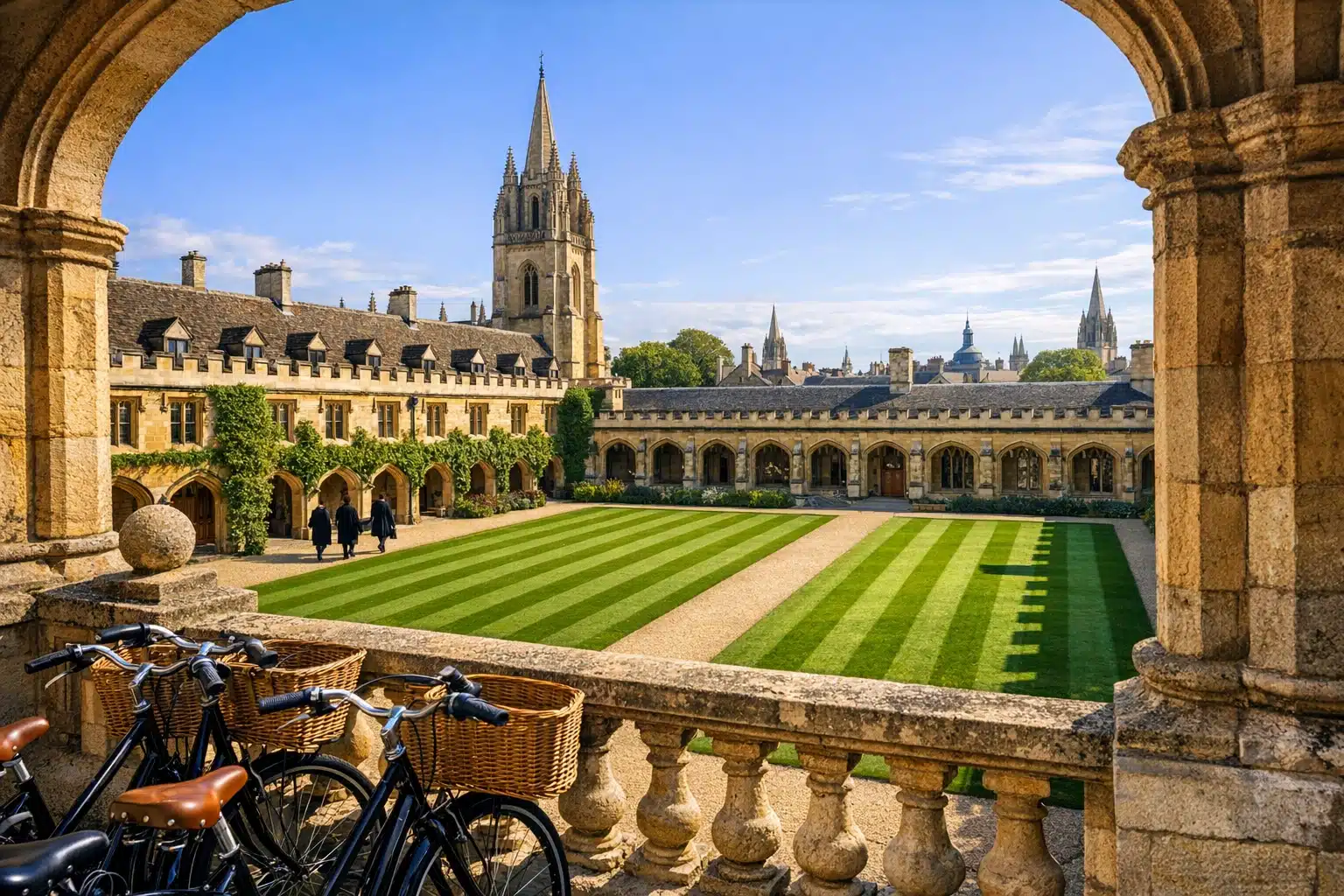
 Artificially generated image
 These Are The Top Ranked Universities In The UK For 2026
Choosing a university in the UK is rarely just about prestige; it influences tuition value, academic fit, internship access, and the kind of city you will learn to navigate. For students aiming at 2026 entry, rankings matter because they gather signals such as research quality, graduate outcomes, and international reputation into one useful starting point. Still, the most important decision comes from understanding what sits behind the numbers. This guide explores the universities that lead the UK field and explains what makes each one stand out.
Outline
1. How UK university rankings work for 2026 and which institutions appear most consistently at the top.
2. Why Oxford and Cambridge remain the defining names in British higher education.
3. How Imperial, UCL, and LSE lead in specialist and metropolitan academic environments.
4. Which other universities form the wider UK top tier, including Edinburgh, St Andrews, Durham, King’s, Manchester, Warwick, and Bristol.
5. How applicants should compare top-ranked universities beyond the headline position on a league table.
How To Read UK University Rankings For 2026
Any article about the top universities in the UK for 2026 has to begin with one important truth: there is no single, universal ranking that every applicant should obey. Different tables reward different strengths. Global rankings such as QS World University Rankings and Times Higher Education usually favor research output, citations, international reach, and academic reputation. Domestic tables such as the Complete University Guide or The Guardian place greater weight on factors that feel closer to student life, including entry standards, student satisfaction, teaching quality proxies, and graduate prospects. That is why a university can be top five in one list and closer to tenth in another without anything mysterious happening behind the curtain.
Still, a pattern is easy to spot. The universities that most consistently occupy the highest band for the UK are Oxford, Cambridge, Imperial College London, University College London, and the London School of Economics, with Edinburgh often close behind in global terms. In domestic tables, St Andrews and Durham also perform exceptionally well, sometimes outranking larger research institutions because their student experience metrics are especially strong. Manchester, King’s College London, Warwick, and Bristol regularly complete the wider top tier, particularly when reputation, research scale, and employer visibility are taken into account.
For 2026 applicants, rankings are most useful when read in layers rather than as a single scoreboard. A practical way to do that is to separate the evidence into three groups:
• global prestige and research strength
• subject-level performance
• student experience and career outcomes
If you are applying for engineering or computer science, for example, Imperial may outrun universities that sit above it in some domestic lists. If you want economics, politics, or international relations, LSE often punches far above its size. If you care about collegiate life, close academic supervision, or a smaller historic setting, St Andrews, Durham, Oxford, and Cambridge suddenly look different from the bigger urban institutions. The ranking table may be the headline, but the detail is the real story. Think of rankings as the opening scene, not the final act.
Oxford And Cambridge: Why They Still Define The Very Top
When people imagine elite education in Britain, they usually picture Oxford’s dreaming spires or the riverbanks and courts of Cambridge. The image may be romantic, but the academic case is very real. These two universities remain at the top because they combine centuries of intellectual reputation with modern research power, selective admissions, deep alumni networks, and distinctive teaching models. They are not simply famous; they are structurally designed to deliver unusually intense academic environments.
Both universities operate through college systems, which means students belong to a smaller community inside the larger institution. That matters more than many applicants first realize. In addition to lectures and seminars, students often receive close-contact teaching through tutorials at Oxford or supervisions at Cambridge. This creates a rhythm of regular essay writing, problem solving, and direct feedback that can feel demanding but also deeply formative. For highly motivated students, it is one of the clearest advantages either university offers.
Oxford is particularly admired for subjects such as law, philosophy, politics, history, English, medicine, and several branches of the sciences. Cambridge has an equally formidable profile and is especially renowned for mathematics, engineering, computer science, natural sciences, and economics, while also excelling in humanities and social sciences. In truth, both institutions are outstanding across most major fields. The better question is not which name sounds grander, but which course structure, assessment style, and academic culture suits you more naturally.
There are also practical differences. Oxford can feel slightly more dispersed across the city, while Cambridge often gives a somewhat more compact sense of movement between colleges and departments. Cambridge’s scientific and technical reputation carries enormous weight with employers in quantitative fields. Oxford’s tutorial tradition, breadth of humanities, and public-policy influence are equally powerful draws. Both attract major research funding, world-class scholars, and students from around the globe. Their graduates feed into academia, finance, consulting, law, technology, government, publishing, and medicine in striking numbers.
Yet even here, nuance matters. These universities are not automatically the best choice for every student. The pressure is real, admissions are intensely competitive, and the style of learning is not ideal for everyone. Some applicants thrive in a large campus-like university with more flexibility and a different social texture. Even so, for 2026 rankings, Oxford and Cambridge remain the benchmark against which every other UK institution is measured, and that is unlikely to change soon.
Imperial, UCL, And LSE: London’s High-Performance Academic Triangle
If Oxford and Cambridge represent the traditional summit, London’s leading institutions form a different kind of elite: faster-paced, more international, and closely linked to major industries, public institutions, and global employers. Imperial College London, University College London, and the London School of Economics and Political Science are regularly among the highest-ranked UK universities because each has built a clear academic identity and delivers exceptional strength in specific areas.
Imperial is the most specialist of the three. Its reputation rests on science, engineering, medicine, business, and increasingly strong computing and data-related disciplines. In global rankings, Imperial often performs extremely well because citation impact, research concentration, and international reputation align naturally with its mission. For students who want a technically focused environment with strong ties to industry, startups, and research labs, Imperial is one of the most compelling options in Europe. It feels less like a broad classical university and more like a precision instrument built for modern STEM education.
UCL offers a broader proposition. It is one of the UK’s largest and most internationally connected universities, with strength across medicine, architecture, education, law, arts and humanities, social sciences, and science. This breadth is a major part of its appeal. A student interested in neuroscience, public policy, urban design, or digital humanities can find not just a strong department but a whole ecosystem of adjacent expertise. UCL also benefits from its location in central London, where museums, hospitals, research institutes, cultural venues, and employers become extensions of the classroom.
LSE is smaller and more focused than UCL, but its influence is enormous. For economics, politics, sociology, international relations, finance, development studies, and related disciplines, it is consistently one of the best-known universities in the world. Employer recognition is especially powerful here, partly because the institution has spent decades shaping debate far beyond academia. If your ambitions point toward public policy, diplomacy, journalism, economics, or the financial sector, LSE deserves serious attention.
There is, however, a London trade-off:
• unmatched access to internships, events, and professional networks
• high living costs and competitive housing
• a fast urban pace that excites some students and exhausts others
For 2026 applicants, these three universities sit near the top not because they resemble one another, but because each offers a sharply defined route to academic and professional distinction.
The Wider Top Tier: Edinburgh, St Andrews, Durham, King’s, Manchester, Warwick, And Bristol
Beyond the headline names lies a group of universities that repeatedly appear in the UK’s upper ranks and, for many students, may offer the better overall fit. This wider top tier includes the University of Edinburgh, University of St Andrews, Durham University, King’s College London, the University of Manchester, the University of Warwick, and the University of Bristol. They differ significantly in scale, atmosphere, and academic emphasis, yet they all command real respect in the 2026 admissions landscape.
Edinburgh is the most visibly global of this group. As one of the UK’s major research universities, it performs strongly in areas such as medicine, informatics, literature, history, and the sciences. Its international profile is reinforced by the city itself, which feels intellectually alive, culturally rich, and instantly recognizable. Students who want a prestigious degree outside London and Oxbridge often place Edinburgh near the top of their list because it combines research depth with a memorable urban setting.
St Andrews is different in almost every way. Smaller, more intimate, and strongly associated with student satisfaction, it often ranks extremely well in domestic tables. It is especially attractive to applicants who value close-knit academic life, strong teaching, and a historic coastal town rather than a sprawling city. Durham, with its own collegiate structure and strong reputation in subjects like law, politics, history, theology, and economics, occupies a similarly distinctive position. Both appeal to students looking for a classic British university experience with a strong sense of community.
King’s College London carries weight in health sciences, law, international affairs, and humanities, while benefiting from direct proximity to major hospitals, legal institutions, and policy organizations. Manchester stands out for scale and breadth. It is one of the UK’s largest universities and a research powerhouse with significant strength in engineering, business, science, social sciences, and the arts. Warwick has built a formidable reputation in business, economics, mathematics, and quantitative subjects, and it is especially popular with students who want strong employer outcomes. Bristol rounds out the group with a balanced profile, respected research, and a city that many students find immediately livable and energizing.
This tier matters because rankings are not only about who finishes first. They are also about who delivers elite opportunities in different forms:
• smaller-community excellence
• research-intensive urban education
• stronger value for a specific subject
• a better social and geographic fit
For many applicants, the smartest choice in 2026 will come from this group rather than from automatically chasing the most famous name on the page.
How To Choose The Right Top-Ranked University In 2026
Once you know which universities dominate the rankings, the next challenge is turning that information into a decision you can actually live with. This is where many applicants make a subtle mistake. They compare prestige but ignore experience. A university is not only a label on a CV; it is the place where you will spend years reading, writing, budgeting, commuting, making friends, and shaping your professional direction. The best-ranked university for someone else may not be the best one for you.
Start with the subject, not the overall league table. A university that sits seventh overall may be stronger for your field than one placed third. Course content matters immensely. Two degrees with the same title can differ in methods, optional modules, assessment patterns, placement opportunities, and research exposure. Read department pages closely. Compare who teaches the course, what students study in each year, whether there is a dissertation or capstone project, and how much flexibility exists to explore related interests.
Then look at outcomes in a grounded way. Graduate employability is valuable, but it should be interpreted carefully. High earnings can reflect subject mix, local industries, or the fact that many graduates move into London-based careers. Think beyond raw salary figures. Ask whether the university has strong placement support, active alumni networks, internship pipelines, or links to employers in your chosen field. A brilliant humanities student may gain more from a university with superb writing culture and internship access than from a technically stronger institution that is less aligned with their goals.
Cost is another decisive factor, especially for 2026 entrants facing high living expenses. London universities may offer extraordinary opportunity, but rent and daily spending can alter the student experience. Scholarships, bursaries, accommodation guarantees, and travel costs deserve the same attention as reputation. The same goes for environment:
• big city or smaller town
• collegiate system or large open campus
• highly competitive atmosphere or more balanced pace
• internationally mixed cohort or a more locally rooted student body
Finally, trust evidence you can feel. Attend open days, watch departmental talks, read course handbooks, and speak with current students when possible. Rankings help narrow the field, but they do not replace judgment. The strongest applicants for 2026 will use rankings intelligently, then choose the place where ambition, affordability, academic style, and personal comfort meet in the same room.
Conclusion For 2026 Applicants
The top-ranked universities in the UK for 2026 are not all trying to be the same institution, and that is exactly why the choice deserves careful thought. Oxford and Cambridge remain the classic summit, Imperial dominates in focused STEM excellence, UCL and LSE thrive through breadth and specialist influence, and universities such as Edinburgh, St Andrews, Durham, King’s, Manchester, Warwick, and Bristol give applicants impressive alternatives with distinct advantages. For prospective undergraduates, postgraduates, international students, and career changers alike, the smartest strategy is to use rankings as a shortlist rather than a script. If you match a strong course with the right environment, realistic costs, and a city that suits your life, the result will matter far more than a tiny gap between two numbers on a table.