 Artificially generated image
 Walmart Is Clearing Out These Countertop Icemakers
Introduction
Countertop icemakers have shifted from niche gadgets to genuinely useful kitchen helpers, especially for households that empty a freezer tray before lunch. When Walmart begins marking these machines down, shoppers get a timely chance to add convenience without stepping into the cost of built-in appliances. That matters for summer hosting, apartment living, RV travel, and busy routines where fresh ice disappears fast. This guide looks at what these clearance deals can signal, which machine styles deserve a closer look, and how to decide whether a lower price is actually a smart buy.
Article Outline
– Why countertop icemakers often appear in clearance assortments and what that means for shoppers.
– The strengths and limits of compact entry-level bullet-ice machines.
– How larger self-cleaning models compare on convenience, output, and day-to-day use.
– Whether premium nugget-style icemakers justify attention when discounts appear.
– A practical checklist for evaluating price, reliability, storage, maintenance, and long-term value.
Why Walmart Clearance Icemakers Draw So Much Attention
Clearance small appliances occupy a special corner of retail psychology. A toaster on markdown feels ordinary. A countertop icemaker, by contrast, feels like a lifestyle upgrade compressed into a box. It promises cold drinks during a heat wave, easier hosting on weekends, and relief for anyone whose freezer can barely keep up with a family that loves iced coffee, smoothies, or refillable water bottles. That emotional pull helps explain why shoppers pay attention when Walmart clears out this category, but there are practical reasons too.
Retailers commonly reduce prices on countertop icemakers during seasonal resets, after heavy summer demand, or when new models are replacing older stock. In other words, a clearance tag does not automatically signal a flawed product. Often it simply reflects timing, shelf space, packaging updates, or an effort to move inventory before the next wave of kitchen gadgets arrives. For shoppers, that can create a narrow but worthwhile window to buy a machine that solves a real problem at a meaningfully lower cost.
What makes these machines relevant is the gap they fill between a freezer tray and a built-in refrigerator dispenser. A standard countertop icemaker usually produces fresh ice in roughly 6 to 10 minutes for the first batch, and many common models can make around 26 to 35 pounds of ice in 24 hours under ideal conditions. That does not mean they store 26 to 35 pounds at once; most hold only a small basket and work best when users transfer extra ice to a freezer. Still, for parties, patios, break rooms, dorms, and compact kitchens, that output can feel transformational.
There is also a broader home-living trend behind the appeal. More people now want appliances that deliver convenience without remodeling. Countertop icemakers match that mood perfectly. They are plug-in, portable, and often light enough to move from kitchen to rec room or from apartment to camper. Their appeal becomes even clearer when you consider the typical pain points they solve:
– Freezer ice takes hours, not minutes.
– Refrigerator dispensers can be slow, noisy, or limited in output.
– Entertaining guests tends to expose how little ice most homes actually keep on hand.
– Small-space living often means choosing compact tools that do one job well.
Still, shoppers should not treat every markdown as a treasure map. Clearance can be a smart buying moment, but only if the machine’s production rate, noise level, cleaning demands, and size match real household needs. That is where the comparison work begins, because the best deal on paper may be the wrong machine in practice. A countertop icemaker is a small luxury, yes, but the right one earns its place by being useful on ordinary Tuesdays, not just at one backyard cookout.
The Entry-Level Models Most Shoppers Notice First
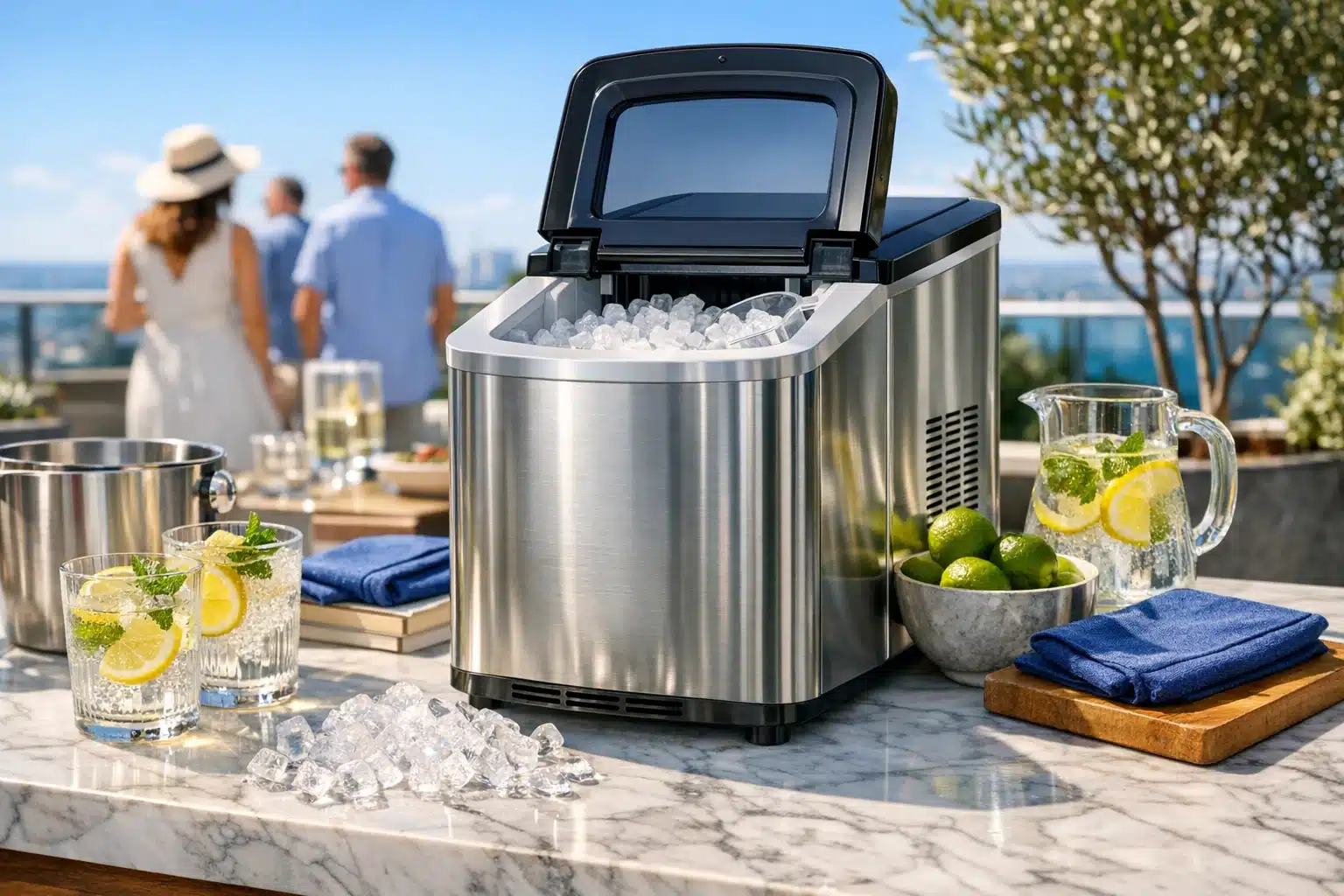
The countertop icemakers most commonly spotted on clearance are usually compact bullet-ice machines. These are the familiar glossy units with a carrying handle, a water reservoir under the lid, and a small basket that fills with rounded ice pieces. Their appeal is easy to understand: they are relatively affordable, simple to operate, and compact enough to fit under standard kitchen cabinets in many homes. If you have ever wanted “more ice, faster” without studying a 30-page manual, this is the category that probably catches your eye first.
In practical terms, entry-level machines are built around speed and simplicity rather than premium texture or massive storage. Many can produce an initial batch in roughly 6 to 8 minutes, and typical daily production claims often land near 26 pounds under favorable room temperature conditions. That is enough for casual family use, a small gathering, or an apartment kitchen where freezer capacity is limited. The trade-off is storage. These units usually hold only a modest amount of finished ice at one time, often around 1 to 1.5 pounds in the basket, so they work best when users scoop fresh ice regularly or transfer excess cubes to a freezer bag.
For many shoppers, that balance makes sense. Entry-level bullet-ice machines shine in scenarios where convenience matters more than luxury. Think of a household that goes through ice for iced tea, protein shakes, or evening drinks but does not need restaurant-grade output. Think of a dorm room where space matters. Think of a vacation rental where guests appreciate extra ice but do not want a machine that dominates the counter. The value proposition is strongest when the machine is solving a modest but frequent problem.
Where these models sometimes disappoint is in the details people overlook during a fast clearance purchase. Noise, for example, varies more than shoppers expect. The hum of a small compressor and the clatter of ice dropping into the basket are normal, but in a studio apartment or quiet office, that soundtrack can feel more noticeable than it did on a bright retail shelf. Cleaning is another reality check. Budget units are not difficult to maintain, yet they still need regular draining, wiping, and periodic descaling if mineral buildup becomes an issue.
When comparing these machines, shoppers should pay attention to a handful of traits instead of focusing only on the markdown sticker:
– First-batch speed versus full-day production claims.
– Basket size and how often you will need to empty it.
– Whether the model offers one or two ice size settings.
– Drain design and ease of cleaning.
– Physical footprint, especially depth and lid clearance.
The best entry-level machine is rarely the one with the most dramatic box graphics. It is the one that fits your counter, your noise tolerance, and your actual routine. Clearance pricing can make these models especially attractive, but their real strength is not glamour. It is habit-forming convenience. Once a kitchen has easy ice on demand, going back to trays can feel like returning to dial-up internet.
Why Midrange Self-Cleaning Icemakers Often Offer the Best Balance
If entry-level models are about quick access and affordability, midrange countertop icemakers aim for a more comfortable long-term experience. These are often the units that tempt practical buyers during Walmart clearance events because they sit in a sweet spot: more features than basic machines, less financial commitment than premium specialty models. They commonly offer larger water reservoirs, somewhat higher daily production, and self-cleaning cycles that reduce the friction of ownership. For households that expect to use an icemaker several times a week rather than just during parties, this class often deserves the closest look.
Many midrange machines still produce bullet-style ice, but they tend to improve the user experience in subtle ways. Water refill frequency may be lower because tanks are larger. Control panels are often easier to read. Windows on the lid may be sturdier, drain plugs may be easier to access, and handles or side grips can make the machine simpler to move. Production claims frequently range from around 28 to 35 pounds per day in ideal conditions, though real-world performance depends heavily on ambient temperature, water temperature, and how often the basket is emptied. Those numbers matter less than the rhythm of use: can the machine keep pace with your household without turning every refill into a chore?
The self-cleaning function, while not magical, is one of the most useful midrange upgrades. It does not eliminate the need for hand cleaning, but it can help circulate water through the system and simplify maintenance between deeper cleanings. That matters because countertop icemakers are exposed to minerals, standing moisture, and the ordinary grime of kitchen life. A machine that is easier to clean is often a machine that stays in service longer and tastes fresher. Convenience is not just about getting ice quickly; it is about removing small annoyances that make people stop using an appliance after the novelty wears off.
Midrange models are particularly attractive for certain kinds of households:
– Families that use ice daily for water bottles, sports drinks, and lunch prep.
– Home entertainers who want more output than a small basic machine can comfortably deliver.
– Shared spaces such as offices, break rooms, or game rooms.
– Shoppers who want a better ownership experience without moving into premium pricing.
Compared with entry-level machines, the trade-offs are usually size and cost. Midrange units tend to occupy more counter space, weigh more, and sometimes run a bit louder simply because they are doing more work. Still, when clearance prices narrow the gap between a basic model and a better-equipped machine, the midrange option can become the smarter value. A slightly higher purchase price may buy easier cleaning, fewer refills, steadier output, and less daily fuss. That is the kind of upgrade that feels sensible rather than flashy.
In shopping terms, this is often where the real clearance winners live. Not because they are the cheapest, but because they are the most balanced. A good midrange icemaker can quietly become one of those appliances you did not think you needed until it starts supporting every dinner, every road trip cooler, and every hot afternoon without complaint.
Premium Nugget-Style Machines: Tempting, Trendy, and Worth a Closer Look
There is a reason nugget-style ice inspires a level of enthusiasm usually reserved for coffee equipment and cast-iron cookware. It is softer, chewable, and especially popular for soft drinks, cocktails, and flavored waters. For some shoppers, that texture alone makes premium countertop icemakers feel irresistible. So when a nugget-style unit appears on clearance, it can seem like the retail equivalent of finding concert tickets in your jacket pocket. The question, however, is not whether this type of machine is appealing. It is whether the markdown makes sense for your habits, your space, and your patience.
Premium countertop icemakers, especially nugget-focused models, tend to cost more because they aim to deliver a specialized result. Their engineering is different from basic bullet-ice units, and that often affects price, noise, weight, and maintenance. Production claims may land in the range of roughly 33 to 44 pounds per day on some models, but shoppers should resist the urge to compare numbers in isolation. Texture, consistency, startup time, and water circulation design can matter just as much as raw output. A machine that produces beloved chewable ice but takes longer to build momentum may still be a perfect fit for someone who values drink experience over speed.
Where premium models justify attention is in use cases where the ice itself is the point. If your household loves iced coffee, mocktails, sparkling drinks, or hospital-style chewable ice, a clearance price may finally bring a once-aspirational appliance into reasonable territory. These machines can elevate everyday routines in a way that sounds trivial until you live with one. The first cold glass on a humid afternoon has a way of making practical calculations feel strangely poetic.
Still, there are reasons to stay grounded. Premium models usually demand more space, and some are significantly heavier than budget units. They may generate more noticeable operational sound. Cleaning can be more involved, and replacement costs outside warranty are not always gentle. If a bargain price persuades you to buy a specialty appliance you will rarely use, the savings are more theatrical than real.
Before buying a premium model on clearance, ask yourself:
– Do I genuinely care about a specific ice texture, or do I mostly need quantity?
– Will this machine live on the counter permanently, or must it be stored between uses?
– Am I comfortable with more maintenance in exchange for better ice?
– Is the discount large enough to narrow the gap between “nice idea” and “good value”?
For the right buyer, a premium icemaker can be a delight rather than an indulgence. For the wrong buyer, it becomes a bulky monument to retail excitement. Clearance pricing makes the category more tempting, but the smart move is to let your daily routine, not the drama of the markdown, decide the outcome.
How to Judge a Clearance Deal Before You Bring One Home
A clearance tag can accelerate decision-making in ways that are not always helpful. The box says limited stock. The price looks lower than expected. Another shopper pauses nearby, and suddenly the machine starts feeling rare. That is exactly why a buying checklist matters. A countertop icemaker may be small, but it touches several parts of daily life: space, electricity, cleaning time, noise, water use, and how you entertain or hydrate at home. The smartest shoppers slow the moment down and test the deal against practical questions.
Start with dimensions. This sounds obvious, yet it is one of the most common reasons appliance purchases disappoint. Measure not just the width of your available counter space, but also the depth, nearby outlet access, and the clearance above the lid. Some units need room for ventilation, and many need enough top space to open easily for refilling, cleaning, or scooping. In a cramped kitchen, even a good machine can become annoying if it blocks another daily task.
Next, think beyond the shelf price. Clearance can reduce the upfront cost, but ownership cost also includes maintenance effort and durability. Check whether the unit has a drain plug that is easy to reach. Look at the control panel and see whether the indicators are intuitive. Review the posted return window and any warranty details available on the packaging or product page. A machine that saves money today but feels unreliable after a month is not automatically a win. Even on discount, convenience should still feel durable.
Then consider how you actually use ice. This is where many purchases become mismatched. A household that only needs extra ice on weekends may be perfectly happy with a basic machine. A family that uses iced drinks every day may appreciate a larger reservoir and self-cleaning cycle. A buyer who loves chewable ice might be happier waiting for the right premium markdown instead of settling for a cheap basic unit that misses the whole point.
A practical in-store or online checklist can help:
– Compare daily production, but also note basket storage capacity.
– Read for cleaning features, especially self-cleaning modes and drainage access.
– Check weight if you plan to move the machine often.
– Scan reviews for recurring issues such as leaking, loud operation, or sensor problems.
– Evaluate whether the discounted price is truly unusual or just modestly reduced.
Finally, remember that the best deal is the one that keeps solving a problem after the excitement fades. A countertop icemaker should make your home easier to run, not more cluttered to manage. If the machine matches your pace, your space, and your expectations, clearance pricing can be a genuine opportunity. If not, the smartest purchase may be the one you leave on the shelf. Good shopping is not just about saving money; it is about buying usefulness at the right moment.
Conclusion: The Right Clearance Buy Depends on How You Actually Live
For shoppers browsing Walmart’s countertop icemaker markdowns, the real opportunity is not simply finding the lowest price. It is finding the machine that fits your kitchen, your ice habits, and your tolerance for maintenance. Basic bullet-ice units work well for light everyday use, midrange self-cleaning models often deliver the best all-around value, and premium nugget machines make the strongest case for buyers who truly care about ice texture. If you compare output, storage, cleaning, size, and warranty details before checkout, a clearance purchase can become one of the more satisfying upgrades in the kitchen. In the end, the smartest deal is the one that keeps your drinks cold, your hosting easier, and your counter space worth every inch.