 Artificially generated image
 What Funeral Caskets May Look Like in 2030
Introduction
Funeral caskets are no longer shaped only by tradition; they are being reshaped by climate concerns, digital culture, urban living, and changing ideas about remembrance. By 2030, the box at the center of a farewell may be lighter, smarter, more personal, and in many cases more sustainable. Families will still want dignity and beauty, but they may also ask where the materials came from, how the casket was made, and what happens to it after burial or cremation. Looking ahead matters because the funeral industry sits where emotion, ethics, and design quietly meet.
Outline
This article explores five connected themes.
– How social change is influencing the shape, style, and purpose of caskets.
– Which materials and finishes are most likely to gain ground by 2030.
– How personalization and digital memorial tools may alter design choices.
– Why manufacturing, pricing, logistics, and regulation will affect what families can actually buy.
– What practical changes families and funeral professionals should expect when planning future funerals.
1. The Social Forces That Will Shape the Casket of 2030
To imagine funeral caskets in 2030, it helps to start with the forces already changing funerals today. The first is the steady rise of cremation in many countries, especially in North America, where national rates have moved above 60 percent in recent years. That shift does not make caskets irrelevant, but it changes what many buyers want. A family arranging a burial may still choose a substantial hardwood or metal casket, yet a family planning a cremation with a viewing often looks for something dignified, simple, and less costly. As a result, the casket market is slowly widening: one end still honors long-standing ceremonial traditions, while the other moves toward lighter, more functional designs.
A second force is environmental awareness. Consumers in many sectors now ask questions that previous generations rarely asked at the point of sale. Is the wood responsibly sourced? Is the finish low in volatile chemicals? Can the casket work in a green burial setting? These questions are not niche anymore. They come from younger planners, from adult children helping elderly parents, and from funeral homes trying to modernize their offerings. By 2030, the appearance of many caskets may reflect this change through cleaner lines, fewer decorative metal parts, and more natural textures. Think less mirror-bright ornament and more satin wood grain, woven fiber, or muted mineral colors.
A third force is cultural tone. In earlier decades, especially in some markets, premium caskets often signaled status. Heavy steel, bronze hardware, thick lacquer, and plush interiors conveyed permanence and expense. That language still matters to some families, and it is unlikely to disappear entirely. Yet a newer tone is taking shape. Many people now value restraint over display. They want an object that feels respectful without seeming theatrical. The casket of 2030 may therefore look less like a formal showroom centerpiece and more like a carefully designed personal item, closer in spirit to bespoke furniture than to ceremonial hardware.
The final force is space. Urban cemeteries, rising land costs, and changing funeral formats all influence design. Smaller chapels, faster scheduling, and more multi-use memorial spaces encourage efficient handling and modular logistics. The future casket may not look futuristic in a science-fiction sense. It will probably not glow, hum, or arrive on hidden rails. Instead, its modernity may be quiet: lighter construction, better ergonomics for staff, adaptable interiors, and a style that fits both traditional services and contemporary memorial settings. In that sense, the casket of 2030 will not abandon ritual. It will simply reflect a society that now measures care in different ways.
2. Materials, Finishes, and the Rise of Sustainable Design
Material choice is where the future will become most visible. Today, many caskets are made from hardwoods such as oak, cherry, walnut, and mahogany, or from metals such as steel, copper, and bronze. Those materials remain important because they are familiar, structurally reliable, and visually associated with funeral tradition. But by 2030, the mix is likely to broaden in noticeable ways. Engineered woods, bamboo, willow, seagrass, recycled fiberboard, molded pulp, wool-lined interiors, and other lower-impact materials may claim a larger share of the market, especially where green burial or lower-cost cremation options continue to expand.
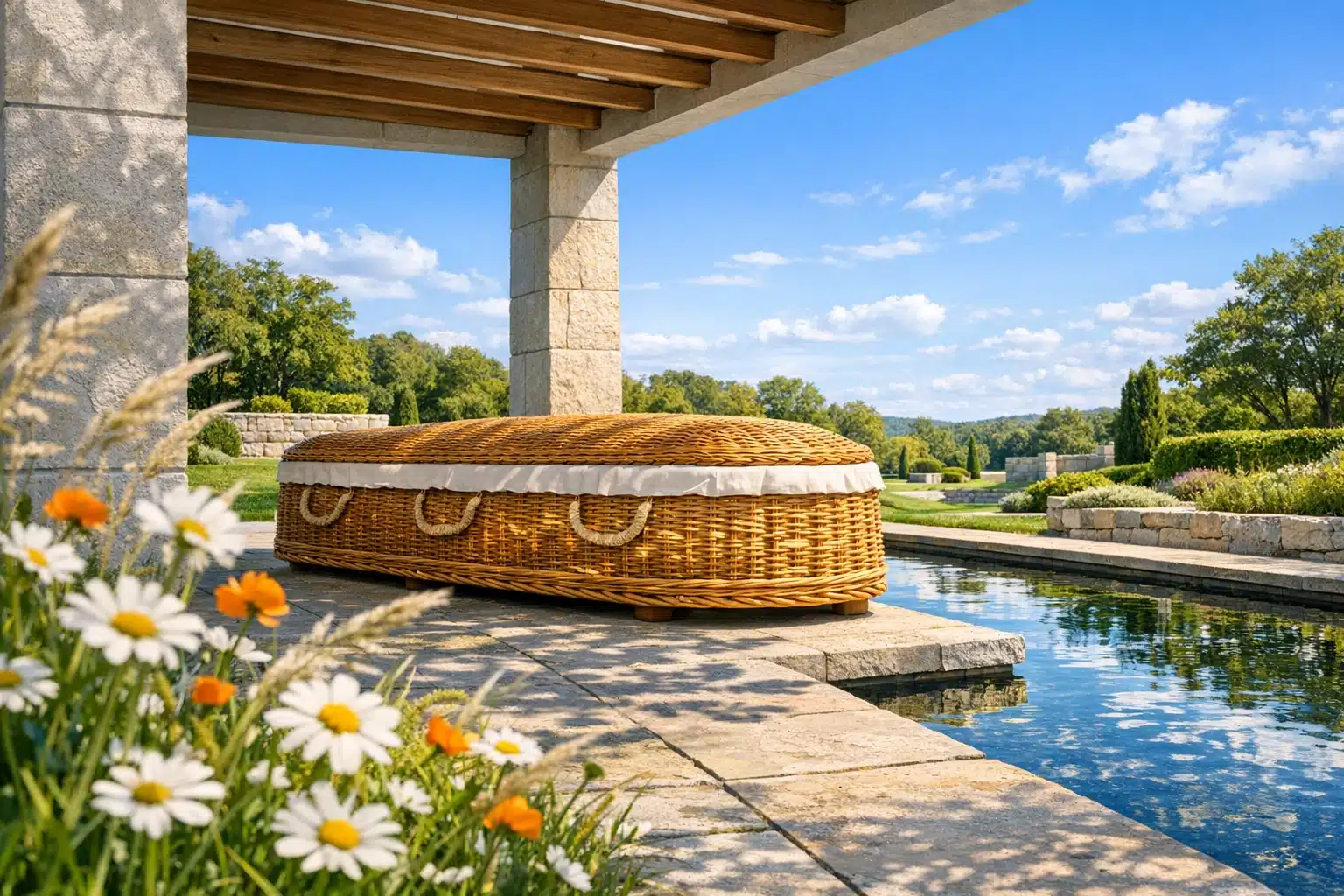
Bamboo is a good example of why alternative materials attract attention. It grows quickly, can be strong for its weight, and offers a calm, natural appearance that many families find appealing. Wicker and willow caskets already exist in some markets and are often chosen for natural burial grounds because they decompose more readily than highly sealed hardwood or metal models. Cardboard or heavy recycled-paper caskets, once viewed as purely budget products, are also being redesigned with better print finishes, sturdier construction, and more dignified visual presentation. In 2030, a sustainable casket may no longer look like a compromise. It may look intentionally modern.
Finishes will matter as much as the base material. Traditional glossy coatings can contain more complex chemical mixtures and are often chosen for shine rather than ecological performance. Future designs are more likely to emphasize water-based stains, natural oils, low-VOC finishes, unbleached fabrics, and minimal metal fittings. Some manufacturers may market forestry certifications, recycled content, or regionally sourced materials more prominently, much the way furniture makers already do. The selling point will not just be environmental virtue. It will also be visual authenticity. A matte ash casket with simple joinery can feel warm and elegant in a way that a thick synthetic gloss does not.
Several material paths are especially likely by 2030:
– Traditional hardwoods will remain for buyers who want classic appearance and ceremonial weight.
– Steel caskets will likely continue in conventional burial markets, though demand may soften at the midrange.
– Bamboo, wicker, and other plant-based options may grow in green burial and eco-conscious segments.
– Recycled paper and molded fiber may become more refined and more widely accepted for cremation or simple burial.
– Interior textiles may shift toward cotton, linen, wool, or recycled fabrics instead of heavily treated synthetics.
One more experimental category deserves mention: mycelium-based materials, grown from fungal structures, have gained attention in packaging and design. They are not yet mainstream in funeral products, and they face practical hurdles involving scale, durability, regulation, and public confidence. Still, by 2030, some limited-edition or green-focused models may use mycelium panels or composite elements. The larger point is this: future caskets may be judged not only by how long they resist change, but also by how responsibly they return to the earth. That is a major philosophical turn, and design tends to follow philosophy.
3. Personalization, Memory Design, and the Gentle Arrival of Technology
If the materials of 2030 speak to environmental values, the decorative details will speak to identity. Funeral personalization is already well established through custom urns, themed services, memory tables, printed programs, tribute videos, and livestreamed ceremonies. Caskets are likely to become part of that broader storytelling system. The future will not necessarily bring flashy screens built into lids or dramatic digital displays. In fact, most families will probably prefer technology that stays discreet. The better comparison is not a smartphone but a well-designed photo frame: useful, respectful, and almost invisible unless you choose to engage with it.
By 2030, more caskets may feature subtle personalization options built into the ordering process. This could include printed or embroidered interior panels, engraved side plaques, color palettes matched to a favorite place or pastime, or interior pockets designed for letters, photographs, children’s drawings, or ceremonial items. Digital fabrication tools make small-batch customization easier than it used to be. A manufacturer can now adapt fonts, motifs, lining colors, and memorial imagery without needing the massive setup costs that once limited custom work. That means personalization may move from premium luxury feature to ordinary expectation.
Some digital features are especially plausible. QR codes or NFC tags could link to an online memorial page containing obituaries, family photos, service recordings, and donation information. Small digital identity markers may also help funeral homes manage logistics, tracking, and documentation with fewer manual errors. For families, though, the emotional use matters more than the administrative one. A small, polished plaque inside the lid that links future generations to stories, music, or archived memories may feel meaningful without becoming intrusive. In that way, the casket becomes not only a vessel for the body but also a gateway to a layered remembrance.
Still, technology in funeral design will have limits. Batteries fail, formats become outdated, websites disappear, and privacy matters. A built-in screen might sound novel today and feel awkward tomorrow. Because funerals rely on trust, anything that looks gimmicky can backfire. The most durable ideas are likely to be low-tech or soft-tech:
– permanent engraving rather than temporary display hardware
– digital links stored externally rather than embedded with fragile electronics
– customization that enhances meaning instead of competing with ceremony
– optional features, not mandatory complexity
There is also a cultural angle here. People increasingly want funerals that feel less generic and more truthful. A casket finished in a soft coastal blue for a sailor, lined in a textile pattern chosen by grandchildren, or etched with a mountain horizon for a lifelong hiker can say more than a page of floral adjectives. By 2030, the best casket designs may do what all strong design does: hold emotion without shouting it. That balance between individuality and restraint is likely to define the most admired models of the coming decade.
4. Manufacturing, Cost, Regulation, and Why the Middle of the Market Will Shift Most
The casket of 2030 will not be shaped by taste alone. It will also be shaped by factories, freight costs, labor, software, cemetery rules, and the economics of funeral retail. Caskets are large items to store and expensive items to ship, which gives the market some unusual characteristics. Funeral homes historically carried showroom inventory because families needed to see and choose quickly. By 2030, more providers may use hybrid models: a smaller floor display, digital catalogs with realistic finishes, and faster regional supply networks for made-to-order or semi-custom products. This change could be especially important for the middle of the market, where families want options but also price clarity.
Manufacturing technology supports that shift. Computer-controlled cutting, digital printing, modular hardware systems, and flexible upholstery production make customization easier than it used to be. Instead of stocking dozens of near-identical caskets, a manufacturer can produce a smaller number of core frames and vary the finish, interior, handles, and decorative panels. That approach reduces waste, lowers storage costs, and gives buyers more visible choice. It also means future caskets may be less tied to a single fixed style. One underlying shell could support a classic funeral look, a minimalist green burial look, or a contemporary personalized look.
Cost pressures will matter just as much as technology. Timber prices, metal prices, energy costs, and transportation expenses have all been volatile in recent years. Families, meanwhile, are becoming more price-aware, partly because more information is available online and partly because many funeral decisions are made under financial strain. The likely result is not the disappearance of premium caskets, but the tightening of the midrange. Consumers may increasingly compare products using practical questions:
– What is the material, and how is it sourced?
– Is the price reflecting craftsmanship, branding, or unnecessary ornament?
– Is the casket appropriate for burial, cremation, or green burial regulations?
– Can it be customized without an extreme surcharge?
Regulation will also keep some future visions grounded in reality. Caskets must meet handling needs, weight-bearing requirements, and local funeral rules. Cremation containers need suitable combustibility characteristics. Some cemeteries require outer burial containers or vaults, which can affect how much emphasis families place on casket durability. Natural burial grounds often restrict treated woods, metal components, or synthetic fabrics. In other words, the casket of 2030 cannot simply be imaginative; it has to work within real systems.
One category likely to grow further is the ceremonial rental casket used for viewings before cremation. These products often combine an attractive outer shell with a removable inner container. They reduce cost for families who want a traditional visitation without purchasing a full premium burial casket. By 2030, rental display systems may become more polished, more customizable, and more openly discussed. That development would reflect a broader industry move toward practical honesty. Families do not just want beauty anymore. They want beauty that makes sense.
5. What Families and Funeral Professionals Should Expect by 2030
For most readers, the most useful answer is also the simplest one: funeral caskets in 2030 will probably look more thoughtful than dramatic. The big changes are unlikely to come from wild futuristic styling. They will come from quieter improvements in material choice, personalization, ergonomics, pricing, and transparency. A future casket may have softer lines, lighter weight, fewer glossy coatings, and more meaningful design details. It may be made from bamboo, engineered wood, or responsibly sourced timber rather than only from heavy metal or highly lacquered hardwood. It may include a memorial plaque that links to a digital archive, but it will still look like something meant to support a solemn human ritual.
Families planning ahead should expect wider choice and stronger contrast between product categories. A traditional burial market will still offer hardwood and metal models for those who value classic appearance. Green burial providers will likely expand plant-based and untreated options. Cremation services may continue to push the design quality of simpler containers upward, making them feel intentional rather than merely economical. The most interesting shift may be that lower-impact and lower-cost no longer automatically mean less dignified. By 2030, many funeral buyers may see simplicity itself as a mark of care.
For funeral professionals, the coming years will reward clarity. Providers who explain materials honestly, display pricing transparently, and understand both traditional and eco-focused preferences are likely to serve families better. The sales conversation may become less about steering people toward ornate upgrades and more about matching products to values, cemetery requirements, and budget. The casket selection room of 2030 may therefore feel less like a showroom built around pressure and more like a design consultation built around suitability.
For anyone preparing in advance, a few practical questions will remain valuable:
– Is this casket intended for burial, cremation, or natural burial?
– What materials, finishes, and textiles are used?
– Does the design fit the type of service we want?
– Are customization options meaningful or merely decorative?
– What part of the price reflects craftsmanship, and what part reflects markup?
– Are there local cemetery or crematorium rules that limit our options?
The future of funeral caskets is not really about containers alone. It is about how a society chooses to express respect when saying goodbye. By 2030, the best caskets will likely combine dignity with realism, beauty with moderation, and tradition with just enough innovation to feel current. They may not look revolutionary at first glance. Yet in their materials, shapes, and stories, they will quietly reveal how much the culture around death has changed.
Conclusion for Families Planning Ahead
If you are thinking about end-of-life planning for yourself or someone close to you, the likely casket trends of 2030 point to more choice, better information, and greater alignment between personal values and funeral design. Expect sustainability to become easier to find, customization to become more accessible, and pricing to become more transparent than in the past. Traditional models will still exist, but they will increasingly sit alongside lighter, simpler, and more environmentally minded alternatives. In practical terms, the future casket will probably be less about display and more about fit: fit for the ceremony, fit for the budget, and fit for the story a family wants to tell.